
Solar EPC Contractors
When designing commercial three-phase solar-plus-storage systems.
Scalable high-voltage LiFePO₄ battery architecture engineered for three-phase commercial inverters, higher-power energy storage and modular C&I applications.
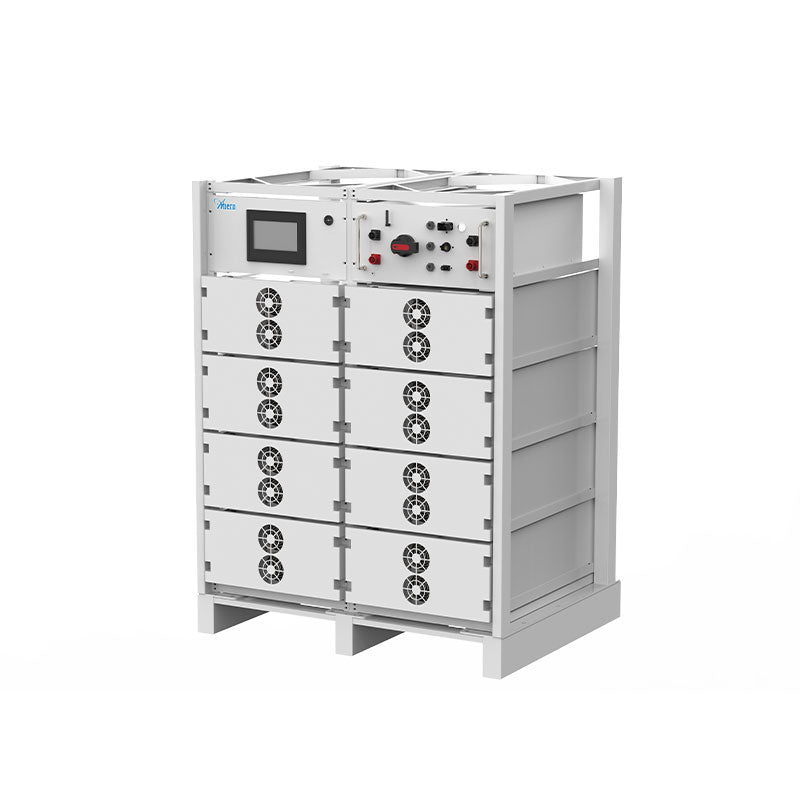
A high-voltage ESS connects multiple battery modules in series to create a higher DC bus voltage suitable for commercial and industrial energy-storage equipment.
Compared with conventional 48V or 51.2V battery architecture, high-voltage battery systems are designed for applications where higher PCS or inverter power, lower DC current and larger energy capacity are required.
Power = Voltage × Current. Raising battery voltage allows the same power to be transferred at lower current.
The right architecture depends on power level, inverter type, current design and project scale.
| Decision Factor | Low Voltage ESS | High Voltage ESS Recommended for C&I |
|---|---|---|
| Typical Architecture | ~48/51.2V class | Multiple modules in series |
| Typical Use | Residential / small off-grid | Commercial / industrial |
| Current at Same Power | Higher | Lower |
| Cable Requirements | Higher current design | Lower current for same power |
| Inverter Type | LV battery inverter | HV hybrid inverter / PCS |
| Expansion | Mostly parallel | Series/cluster architecture |
| System Complexity | Simpler | Requires coordinated HV BMS |
| Best Fit | Smaller systems | Higher-power C&I systems |
For an illustrative 50kW DC power transfer, raising voltage changes the current required by the conductors.
When designing commercial three-phase solar-plus-storage systems.
When matching battery clusters with compatible HV PCS or hybrid inverters.
When larger power demand makes conventional 48V architecture less practical.
When building a portfolio beyond residential wall-mounted and rack-mounted batteries.
High-voltage battery compatibility is not determined by voltage alone. The battery and inverter must match across the full DC operating voltage range, charge/discharge current, BMS communication protocol, protection logic and firmware configuration.
Battery operating voltage must remain within the inverter or PCS DC range.
Power and current limits must be coordinated.
CAN / RS485 or other supported protocols must be correctly mapped.
SOC, alarms and charge/discharge limits must be exchanged correctly.
Validated firmware combinations reduce field integration risk.
High-voltage energy storage is a system-engineering task rather than a standalone battery purchase.
Anern’s product scope covers lithium batteries, solar inverters, PV modules and complete solar-storage solutions. Combined with a production base of approximately 30,000 m² and a 100+ R&D team, this enables Anern to support customers from battery selection through solar-plus-storage system configuration.
Anern Store currently lists commercial high-voltage configurations at approximately 60kWh, 128kWh and 225kWh.
 Compact C&I configuration
A compact commercial configuration for distributed solar-plus-storage projects and scalable system planning.
 Modular rack architecture
A modular high-voltage rack architecture for higher-energy C&I applications and three-phase inverter integration.
 Higher-capacity cluster
A higher-capacity battery cluster option for commercial facilities, EPC tenders and integrated energy projects.
Anern supports international solar and energy storage projects through manufacturing, system integration and model-specific compliance documentation. For complete solar-plus-storage projects, compliance should be verified across the battery, inverter/PCS, PV module and complete ESS—not through a single certificate alone.
| Target Market | Lithium Battery / BESS | Solar Module | Inverter / Grid Connection | Project-Level Verification |
|---|---|---|---|---|
| European Union | IEC 62619; IEC 63056 where applicable | IEC 61215; IEC 61730; IEC 62941 manufacturing quality framework | CE-related safety requirements + destination-country grid code | Verify exact certificates against selected model and project country |
| United Kingdom | IEC-based battery safety requirements | IEC 61215; IEC 61730 | UK electrical requirements + applicable G98/G99 grid connection requirements | Confirm product-specific UK documentation before tender submission |
| United States | UL 9540 system requirements; UL 9540A thermal-runaway testing where applicable | Applicable UL / IEC PV module requirements | Applicable inverter safety, IEEE / utility interconnection requirements | AHJ, fire code and utility requirements must be reviewed project by project |
| Australia / New Zealand | IEC battery safety documentation + local ESS requirements | IEC 61215; IEC 61730 | Applicable AS/NZS inverter and grid-connection requirements | Verify equipment listing and installation requirements for the project |
| Middle East | IEC 62619 / IEC-based BESS specifications commonly requested | IEC 61215; IEC 61730 | Country / utility-specific inverter and grid requirements | Tender specifications and local authority requirements take priority |
| Africa | IEC-based battery safety documentation commonly used in international tenders | IEC 61215; IEC 61730 | Utility and country-specific grid requirements | Requirements differ significantly by country and project owner |
| Latin America | IEC-based battery / ESS safety requirements | IEC 61215; IEC 61730 | Country-specific inverter and utility grid code | Review local electrical, utility and import requirements before supply |
Use model-specific documentation and destination-market requirements during project selection and tender review.
| System Layer | International Reference | Why EPC Buyers Care |
|---|---|---|
| 01PV Modules | IEC 61215 | Module design qualification / performance durability |
| 02PV Modules | IEC 61730 | PV module safety qualification |
| 03PV Manufacturing | IEC 62941 | Manufacturing quality system for certified PV modules |
| 04Lithium Battery | IEC 62619 | Industrial lithium battery safety |
| 05ESS Battery | IEC 63056 | Battery safety for electrical energy storage systems |
| 06North America ESS | UL 9540 | Complete ESS / equipment safety |
| 07North America Fire Testing | UL 9540A | Thermal runaway fire propagation test method |
| 08Inverter / PCS | Safety + local grid compliance | Grid connection varies by target market |
| 09Factory QMS | ISO 9001 | Quality management |
| 10Environmental Management | ISO 14001 | Environmental management |
| 11Occupational Safety | ISO 45001 | Occupational health & safety |
EPC contractors should verify compliance at the battery, inverter/PCS, PV module and complete-system level according to the destination market.
Send us your inverter model and project requirements for configuration support.
Short answers for early-stage system selection, compatibility and compliance planning.
Share your required power, energy, inverter model and target market. Anern can support battery selection and system configuration.
Start Your Project