














Ensuring the reliability and longevity of solar panels is paramount for anyone seeking energy independence. This guide details the foundational IEC standards – IEC 61215, IEC 61730, and IEC 62108 – which govern photovoltaic (PV) module testing. You will discover their crucial role in preventing early failures, understand the evolution from older standards (like IEC 61646), and learn why advanced testing protocols are vital for predicting long-term performance across diverse environments. This comprehensive overview helps you make informed decisions for your solar and energy storage solutions.
Introduction: The Foundation of Solar Panel Reliability
The solar energy industry relies heavily on the quality and durability of photovoltaic (PV) modules. Robust testing ensures that solar panels perform as expected, providing consistent power for years. International Electrotechnical Commission (IEC) standards establish a baseline for PV module quality, playing a critical role in reducing early failures and building confidence in solar technology.
Understanding Core PV Module Testing Standards
PV systems demand specific skills and rigorous testing. The IEC has established several key standards to address different types of PV modules. These standards have proven effective in reducing early failures, often referred to as “infant mortality,” in PV modules.
IEC 61215: Design Qualification for Crystalline & Thin-Film
IEC 61215 is the "gold standard" for design qualification and type approval of PV modules. Historically, this standard covered only crystalline silicon, while thin-film was covered by IEC 61646 (now withdrawn). Since 2016, the IEC 61215 series covers all terrestrial PV technologies:
- IEC 61215-1-1: Specific requirements for Crystalline Silicon (c-Si) modules.
- IEC 61215-1-2/3/4: Specific requirements for Thin-Film technologies (CdTe, CIGS, and a-Si), effectively replacing the old IEC 61646.
Key tests in this series include:
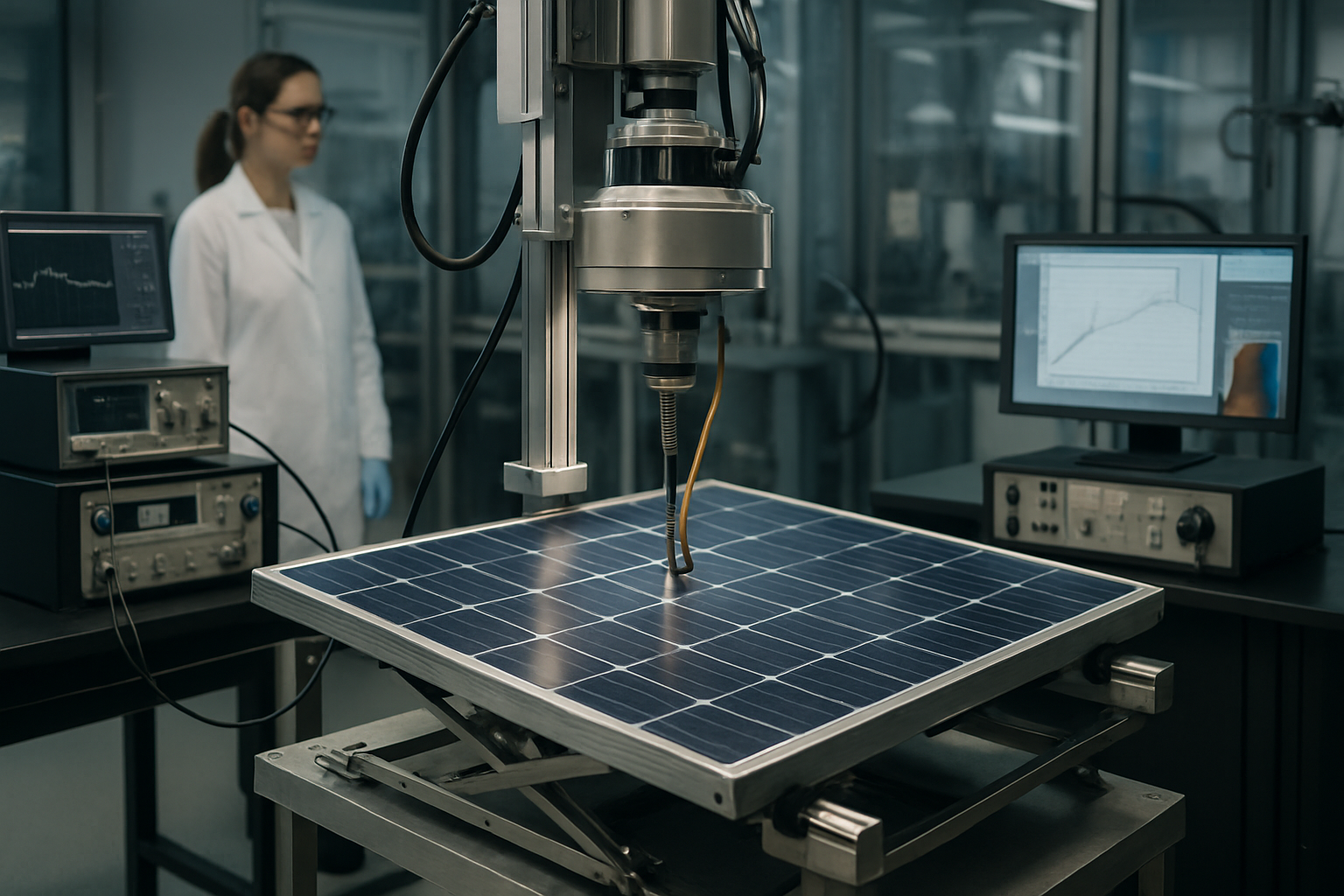
- Thermal Cycling: Modules undergo repeated temperature changes (-40°C to +85°C) to test material fatigue and connection integrity.
- Damp Heat: Panels are exposed to high humidity (85%) and temperature (85°C) to assess resistance to moisture ingress and corrosion.
- Humidity-Freeze: This test combines high humidity with sub-zero temperatures to check for delamination.
- Mechanical Load: Modules are subjected to static and dynamic loads to simulate wind and snow pressure.
- Hail Resistance: Impact tests determine a module's ability to withstand hail strikes.
IEC 61730: Photovoltaic Module Safety Qualification
While IEC 61215 focuses on performance, IEC 61730 focuses on safety. It is mandatory in most markets for legal installation. It verifies that the module is safe for electrical operation and withstands fire hazards. It covers:
- Electrical Shock Hazard: Ensuring insulation and grounding are sufficient to protect users.
- Fire Hazard: Testing the module's resistance to external fire sources.
- Mechanical Integrity: Ensuring the module won't break in a way that creates a safety risk.
IEC 62108: Concentrator Photovoltaic (CPV) Modules
Concentrator Photovoltaic (CPV) modules utilize optics to focus sunlight onto small, high-efficiency solar cells. IEC 62108 provides the design qualification for these specialized modules. Although CPV is a niche market compared to standard panels, these systems often incorporate tracking mechanisms and are designed for high-irradiance environments, necessitating tests that evaluate their performance under concentrated light and mechanical movement.
Beyond Basic Compliance: Addressing Real-World Challenges
While IEC standards are fundamental, they possess certain limitations that require a deeper look into PV module performance and longevity.
Limitations of Current IEC Standards
Current IEC standards are designed to screen for "infant mortality" (early failure) rather than predicting a 25-year lifespan. Most commercial modules pass these qualification tests, meaning the basic certification does not effectively differentiate between "good" and "premium" products.
For instance, the standard thermal cycling test in IEC 61215 imposes only 200 cycles. However, extended durability protocols (such as IEC TS 63209) often recommend 500 or more cycles to accurately reflect the stress modules experience over a full lifespan, especially in regions with significant daily temperature fluctuations.
The Need for Enhanced Testing and Quality Infrastructure
Recognizing these gaps, the industry has adopted enhanced testing protocols. Several technical specifications (TS) have been published for specific tough environments:
- IEC TS 63126: Guidelines for qualifying PV modules for operation at high temperatures.
- IEC TS 63397: Protocols for increased hail resistance testing.
- IEC 61701: Salt mist corrosion testing for coastal areas.
For smart mini-grids, a robust quality infrastructure includes certified installers, equipment certification, and comprehensive system testing to ensure reliable energy delivery.
Ensuring Longevity and Performance in Diverse Environments
The operational environment significantly impacts a PV module's performance and lifespan. Understanding these factors is crucial for selecting the right products.
Impact of Environmental Factors
One common factor limiting the performance is dust (soiling), which causes partial shading and reduces light transmission. Climatic conditions like desert environments, coastal areas, and islands can also present unique challenges, demanding modules that can withstand extreme heat, abrasive particles, or salt mist corrosion.
The Path to Reliable Energy Solutions
For your energy solutions, whether it is a home energy storage system or an off-grid solar setup, the underlying quality of the PV modules is critical. By choosing products that not only meet basic IEC standards but also pass enhanced reliability testing (like PVEL or IEC TS 63209), you invest in long-term reliability. This commitment ensures that your solar energy system provides consistent, dependable power.
Moving Forward: A Commitment to Enduring Solar Power
The journey towards a sustainable energy future is built on reliable technology. While foundational IEC standards like 61215 and 61730 provide essential benchmarks, the evolving demands of diverse climates necessitate a continuous push for more rigorous testing. By embracing advanced qualification protocols, we can ensure that solar panels deliver consistent performance and durability for decades.
Frequently Asked Questions
What is the difference between IEC 61215 and IEC 61730?
IEC 61215 is for design qualification (performance and reliability), ensuring the panel can survive environmental stress. IEC 61730 is for safety qualification, ensuring the panel won't cause electric shock or fire hazards. They are almost always required together.
What happened to IEC 61646?
IEC 61646 was the old standard for thin-film modules. It was withdrawn in 2016 and merged into the IEC 61215 series. Now, thin-film modules are tested under IEC 61215 (specifically parts 1-2, 1-3, or 1-4 depending on the material).
Do IEC standards guarantee 25-year performance?
No. Basic IEC standards are "pass/fail" tests designed to screen out early failures. They do not simulate a full 25-year lifespan. For long-term durability prediction, look for "Extended Stress Testing" protocols like IEC TS 63209.
Why are additional tests needed for specific climates?
Standard tests use average conditions. If you live in a desert (high heat) or a hail-prone region, basic tests may not be enough. Standards like IEC TS 63126 (High Temperature) or IEC TS 63397 (Hail) provide the extra verification needed for those specific environments.

Leave a comment
All comments are moderated before being published.
This site is protected by hCaptcha and the hCaptcha Privacy Policy and Terms of Service apply.