
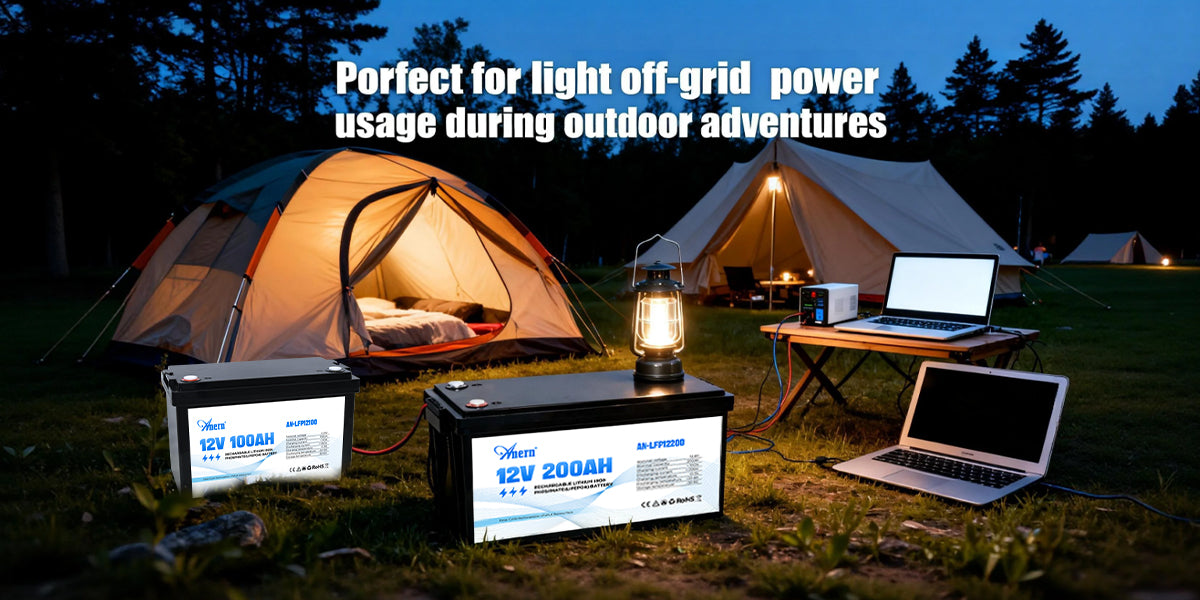
For off-grid projects, most performance issues do not come from panels or inverters. They usually come from a battery bank that is too small, too optimistic, or sized with rough guesses. A 12V LiFePO4 battery is a strong foundation for small off-grid systems, but it still needs a clear sizing method.
Installers, integrators, and project owners need a way to translate load profiles and autonomy targets into a concrete number of 12V LiFePO4 batteries. The goal is simple: meet off-grid power requirements, protect runtime commitments, and avoid overspending on capacity.
What Does Your 12V Off-Grid System Need to Power Each Day?
For professional work, sizing starts with a load assessment, not with a preferred battery model. A 12V LiFePO4 system should reflect the real operating profile of the site.
A basic survey for each project should capture:
- Load name and function
- Nominal power in watts
- Quantity
- Operating hours per day
- Priority level (critical or flexible)
Here is an example for a small off-grid communications or monitoring site:
| Load | Power (W) | Qty | Hours per day | Daily Wh | Priority |
|---|---|---|---|---|---|
| LED security lighting | 15 | 6 | 4 | 360 | Critical |
| DC network router/switch | 12 | 1 | 24 | 288 | Critical |
| Camera and sensor package | 18 | 4 | 24 | 1,728 | Critical |
| Laptop service outlet | 80 | 1 | 2 | 160 | Flexible |
Total daily energy is:
360 + 288 + 1,728 + 160 = 2,536Wh
Many integrators separate critical and flexible loads at this stage. The 12V LiFePO4 battery bank is often sized primarily around critical daily energy. Flexible loads then become a controllable overhead that can be limited during low production periods.
The same method applies to other small off-grid systems: rural kiosks, clinics, farm control panels, and small industrial sites. Once daily watt hours are known, LiFePO4 system sizing becomes a calculation rather than a debate.
How Do You Turn Daily Wh Into Required 12V LiFePO4 Battery Capacity?
With daily watt hours defined, the next step is to translate that figure into amp hours at 12V. A 12V LiFePO4 battery bank must cover system losses and autonomy targets, not just the nameplate load.
Step 1: Allow for System and Inverter Losses
If the project uses an inverter for AC loads, part of the stored energy becomes heat. Many inverters operate around 90 to 94 percent efficiency. For design work, a 90 percent efficiency assumption is simple and conservative.
Using the earlier example:
- Daily loads: 2,536Wh
- Adjusted for losses: 2,536Wh ÷ 0.9 ≈ 2,818Wh
This adjusted energy is what the 12V LiFePO4 system must deliver from the battery bank each day.
Step 2: Define Days of Autonomy
Days of autonomy define how long the site should operate with minimal or no charging. This is a business decision as much as a technical one.
Common autonomy targets for 12V LiFePO4 systems:
- Small monitoring or telecom sites: 1.5 to 2 days
- Rural clinics, micro-retail, or small office loads: 2 to 3 days
Assume the communications site must run for 2 days without charging:
2,818Wh × 2 = 5,636Wh of usable energy
Step 3: Convert Wh to Ah at 12V
Now convert watt-hours to amp-hours. The basic relation is:
Ah = Wh ÷ V
For a 12V LiFePO4 battery bank, 12V is commonly used for planning. Some designers use 12.8V as the nominal voltage. Using 12V gives a conservative result.
For 5,636Wh:
5,636Wh ÷ 12V ≈ 470Ah
This value is usable capacity at 12V that the project expects to draw during the autonomy window.
Step 4: Apply Depth of Discharge for LiFePO4
One important advantage of a LiFePO4 12V battery bank is a deeper usable depth of discharge compared with many legacy chemistries. Design practice often uses around 80 percent usable capacity across the battery life for daily cycling.
The relation is:
Required rated Ah = Usable Ah ÷ Allowed depth of discharge
Using 80 percent usable:
470Ah ÷ 0.8 ≈ 588Ah
So this site requires roughly 580 to 600Ah of rated capacity at 12V. This figure guides the final configuration of the 12V LiFePO4 battery bank.
How Many LiFePO4 Battery 12V 100Ah or 200Ah Units Does That Mean in Practice?
Once the required amp hours are known, the next question is how to implement that capacity using standard modules. In many off-grid projects, the LiFePO4 battery 12V 100Ah is the basic building block. A LiFePO4 battery 12V 200Ah is common in higher-demand systems.
Typical ratings and approximate energy content:
LiFePO4 battery 12V 100Ah
- Rated capacity: 100Ah
- Energy content: around 1.2 to 1.3kWh
LiFePO4 battery 12V 200Ah
- Rated capacity: 200Ah
- Energy content: around 2.4 to 2.6kWh
For 12V systems in the 400 to 600Ah range, some practical configurations include:
- Three LiFePO4 battery 12.8V 200Ah units in parallel (≈600Ah total)
- Up to four LiFePO4 battery 12.8V 100Ah units in parallel (≈400Ah total) for lighter sites that need less autonomy
This approach respects the typical four-parallel limit used in Anern-style 12V LiFePO4 systems. If a project needs more capacity than four 12V modules in parallel can provide, it is usually better to step up to a 24V or 48V bank rather than building larger 12V parallel arrays.
When you design off-grid systems using Anern’s 12V LiFePO4 batteries, the BMS limits matter as much as the amp-hour math. These products are typically designed for up to four units in series or up to four units in parallel. In practice, this gives you:
- Up to 48V nominal when four 12.8V modules are wired in series
- Up to 800Ah of rated capacity at 12V when four 200Ah modules are wired in parallel
Staying inside this “up to four in series or four in parallel” window keeps fault currents, balancing behavior, and warranty expectations aligned with how the battery was engineered.
For 12V-only banks wired in parallel, the system voltage stays at 12V while the amp-hours add up across modules.
The choice between 100Ah and 200Ah units depends on:
- Serviceability and ease of replacing a single module
- Available footprint and enclosure constraints
- Preferred current per unit and wiring layout
Larger projects might later move to 24V or 48V banks. The same method still applies, but with different nominal voltages and series connections. For a pure 12V LiFePO4 system, parallel combinations of 100Ah and 200Ah units remain the typical approach.
Quick LiFePO4 System Sizing Examples for Typical Off-Grid Setups
The same sizing process can support a range of project types. Two short examples show how the numbers tend to fall for different 12V LiFePO4 system designs.
Remote Monitoring or Telecom Site
Consider a small telecom or SCADA site with:
- Continuous network and sensor loads
- LED perimeter lighting for several hours at night
- Minimal onsite staff presence
Daily energy might land around 2.5 to 3kWh. With 90 percent system efficiency, 2 days of autonomy, and 80 percent depth of discharge, the calculation points to roughly 500 to 650Ah at 12V.
Typical solution:
- Three LiFePO4 battery 12.8V 200Ah units in parallel for sites at the upper end of this range
- Or up to four 12.8V 100Ah units in parallel for lighter telecom loads that sit closer to 500Ah
When the required capacity starts to push beyond what four 100Ah modules can provide, it is usually more practical to move to 200Ah modules or to a 24V or 48V LiFePO4 system instead of adding a second 12V parallel string.
Small Rural Clinic or Retail Kiosk
A small rural clinic or kiosk may combine:
- Lighting
- A DC fridge for medicines or drinks
- Basic IT and networking
- Occasional small appliance use
Daily loads may range from 3 to 4kWh. With similar efficiency numbers and an autonomy target closer to 2.5 or 3 days, required capacity often reaches the 600 to 800Ah range for a 12V LiFePO4 battery bank.
In practice, many designers use:
- A 24V or 48V system, once power levels reach this range, especially for clinics with larger fridges or IT loads
- Where 12V compatibility is essential, they typically build banks from three or four 12.8V 200Ah LiFePO4 batteries in parallel, staying within the common four-parallel limit instead of trying to extend the 12V array beyond a single parallel group
In both examples, the design flow stays consistent: daily watt hours, losses, autonomy, voltage, depth of discharge, then conversion into standard 12V LiFePO4 modules.
Choose a 12V LiFePO4 Battery System Size You Can Rely on Off the Grid
Off-grid reliability is not a guess. It is the result of a documented sizing process and a chemistry that can sustain daily cycling. A well-designed 12V LiFePO4 battery system connects real load profiles, realistic autonomy targets, and clear module choices.
For installers and project owners, the workflow is repeatable. Capture daily watt-hours from a proper load survey. Adjust for losses and desired autonomy. Convert into amp-hours at 12V. Apply an appropriate depth of discharge for LiFePO4. Then select a bank of LiFePO4 battery 12V 100Ah or 12V 200Ah units that meet the requirement with a sensible design margin.
When you apply this sizing workflow to Anern’s 12V LiFePO4 products, it also keeps each design within the intended limit of up to four batteries in series or up to four in parallel. That protects uptime, simplifies client conversations, and supports predictable lifecycle costs across your off-grid portfolio.
FAQs: 12V LiFePO4 Battery Sizing for Off-Grid Projects
Q1. How much design margin should installers add when sizing 12V LiFePO4 banks?
For commercial or repeatable projects, many installers add 10 to 25 percent capacity above the calculated value. This covers unplanned loads, shading, battery aging, and forecast errors. Some teams also separate a comfort margin for end users from a technical margin so runtime promises remain realistic.
Q2. How does low temperature affect 12V LiFePO4 battery sizing in outdoor projects?
LiFePO4 capacity drops as temperature falls, especially near or below freezing. For cold sites, designers often oversize the 12V LiFePO4 battery bank based on manufacturer discharge curves, add insulation or mild heating, and choose models with low-temperature charge protection. These steps help protect cells and maintain expected runtime.
Q3. When should a project move from a 12V LiFePO4 system to 24V or 48V?
A 12V LiFePO4 system fits small sites with modest power, such as remote monitoring and light loads. Once continuous demand climbs above roughly 1 to 2 kW, current and cable size become harder to manage. At that point, many integrators shift to 24V or 48V to reduce current, cut resistive losses, and control copper cost.
Q4. What charge current and C-rate are reasonable for 12V LiFePO4 batteries in off-grid designs?
System designers usually keep a continuous charge current around 0.2C to 0.5C, based on rated amp hours. For a LiFePO4 battery 12V 100Ah, that means about 20 to 50 amps. Some batteries allow higher currents, but long-term cycle life, temperature limits, and charger ratings should guide the final selection.
Q5. How can installers monitor and maintain multi-battery 12V LiFePO4 systems over time?
For multi-battery banks, professional teams rely on BMS data and remote monitoring where available. They track pack voltages, cell balance, peak and continuous currents, and temperature trends. Regular visual checks of terminations and protection devices, plus documented configuration changes, help keep 12V LiFePO4 systems predictable throughout their service life.
