
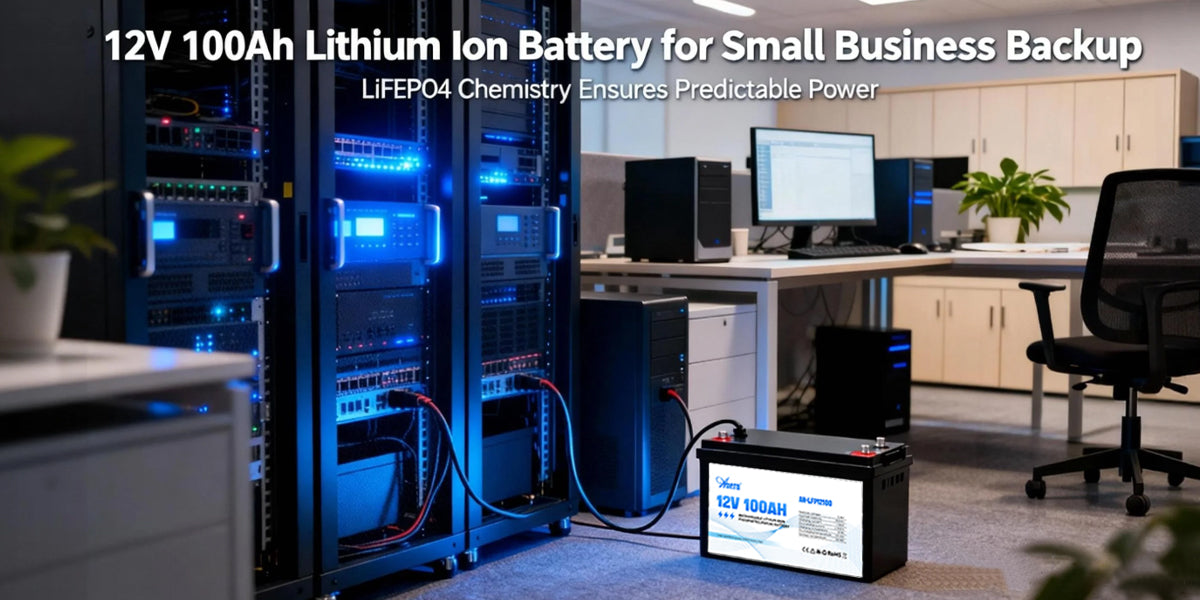
A power outage rarely feels like “just a blackout” inside a small business. It breaks the flow of sales and service within minutes. Card payments fail, POS systems stop syncing, Wi-Fi drops, and security cameras can go offline. Customers walk out. Staff waste time troubleshooting instead of helping people. A single LiFePO4 battery backup can keep your most critical devices running, protect revenue, and reduce the stress that comes with unexpected grid failures.
Why a 12V 100Ah Lithium Ion Battery Makes Sense for Small Business Battery Backup
Small businesses need backup power that behaves predictably. A 12V 100Ah lithium-ion battery in LiFePO4 chemistry fits those needs well.
1. The energy capacity is useful for real-world “critical loads.” A typical 12V 100Ah LiFePO4 pack is rated around 12.8V and 100Ah, which equals roughly 1280Wh of stored energy (12.8 × 100). That is a solid reserve for POS, networking, and security equipment.
2. It supports long service life. Many 12V 100Ah LiFePO4 batteries are rated for 4,000+ cycles under common test conditions. That reduces replacement headaches and helps lower total cost over time.
3. Modern packs include a battery management system (BMS). A BMS helps manage charging, discharging, and protection events. It adds stability, which matters when your store depends on electronics behaving normally.
4. It stays low-maintenance. No fuel rotation. No engine testing. No noise complaints. Your backup can sit ready, then work when needed.
For business owners, this is the real value: your essential tools keep running, and your team stays in control.
What a 12 Volt 100Ah Lithium Battery Should Power First (POS, Wi-Fi, Security)
Backup power works best when you treat it like a priority list. Some devices protect revenue. Others protect safety. A few are nice to have, yet drain capacity quickly.
A 12-volt 100Ah lithium battery should focus on the equipment that keeps you open for business.
Tier 1: Checkout and Connectivity
These loads support sales and customer flow:
- POS terminal, tablet, or checkout computer
- Payment reader
- Modem and router
- Small network switch (if your layout needs it)
- Receipt printer (only if your workflow depends on it)
This is the foundation of a battery backup for POS systems. It prevents the most expensive kind of downtime, the moment customers cannot pay.
Tier 2: Security and Control
These loads reduce operational risk:
- Cameras
- NVR or DVR
- Alarm panel
- Door access equipment (when applicable)
Security systems tend to draw steady power. They are a good match for battery backup.
Tier 3: High-Draw Comfort Loads
These loads can shrink the runtime quickly:
- Space heaters
- Microwave ovens or hot plates
- Large lighting circuits
- Big refrigeration compressors
One battery can protect essentials for a long time. It cannot cover every appliance in a typical shop for hours. Keeping the scope tight is what makes the plan succeed.
How Long Will a 12V 100Ah Lithium Ion Battery Backup Actually Last?
Runtime planning gets easier when everything is converted into watts and watt-hours.
A 12V 100Ah lithium-ion battery stores roughly 1280Wh of energy. In most stores, you will use an inverter to supply AC power. Inverter efficiency varies by design and by load. Many setups land in the 85% to 95% range during battery operation, so planning around 90% gives a realistic estimate.
Runtime Estimate
Estimated runtime (hours) = (Battery Wh × inverter efficiency) ÷ total load (W)
Here are practical examples for common “keep-the-business-running” bundles. These are estimates. Your exact numbers depend on your device labels.
| Critical Load Bundle | Typical Devices Included | Approx. Load (W) | Est. Runtime (hrs) |
| Checkout Essentials | POS + modem + router | 50–70W | 16–23 |
| Checkout + Screen | Essentials + monitor or small PC | 100–130W | 9–12 |
| Checkout + Security | Essentials + NVR + cameras | 140–180W | 6–8 |
| Front Counter “All Core” | POS + screen + security + switch | 180–220W | 5–6 |
A Few Practical Notes
- Loads creep over time. A phone charger here, a label printer there, and the runtime shortens. Label your backup outlets as “critical only.”
- Printers can spike. Some printers draw extra power while heating or cutting. Keep your inverter sized with a margin.
- DC can extend the runtime. Routers and modems often run on DC power adapters. A DC-first setup can reduce conversion losses, although it requires careful planning.
For many owners, this section answers the biggest concern. A single battery can keep the “brain” of the store alive long enough to protect revenue and reduce stress.
Business Continuity Power: Why Battery Backup Beats Small Generators for Daily Operations
Generators solve one problem and create a few new ones. They provide high wattage, yet they also bring noise, fumes, storage rules, and maintenance. Many small businesses buy one, then use it less than expected.
A 12V 100Ah lithium-ion battery delivers a different kind of business continuity power. It supports the systems that matter most, with fewer operational burdens.
Day-to-Day Advantages of Battery Backup
Battery backup stays quiet during customer hours. It can be used indoors when installed correctly. It responds quickly to electronics. Testing and readiness checks stay simple.
When a Generator Still Makes Sense
Generators work better for extended outages with heavy loads, such as HVAC or large refrigeration. They also fit sites that need high power for production equipment. In locations with frequent multi-day grid issues, a generator can still play a role.
Many businesses use battery backup first, then add larger solutions later. The battery carries the “core operations” role. That is where it shines.

What Do You Need to Build a Reliable Battery Backup for POS Systems with 12V 100Ah Lithium?
System design matters as much as the battery. Your equipment needs clean, stable power, along with proper protection and safe wiring.
A solid build around a 12V 100Ah lithium-ion battery includes the components below.
Essential Hardware
- LiFePO4 battery (12V 100Ah)
- Pure sine wave inverter
- DC fuse or breaker near the battery
- Correct cable gauge for the inverter current
- AC outlet strip or small “critical load” panel
LiFePO4-compatible charger (if the inverter does not include charging)
Why Pure Sine Wave Inverters Are Worth It
POS devices, routers, and small computers often behave best on clean power. Pure sine wave output supports stable operation for sensitive electronics, which reduces reboots and weird power-supply behavior.
Helpful Upgrades
- Inverter-charger combo (simplifies charging and switching)
- Basic monitoring (voltage and remaining capacity)
- Dedicated enclosure or shelf to keep the setup organized and protected
If your goal is a dependable small business battery backup, this hardware list keeps the solution simple and scalable.
How to Set It Up Safely in a Small Business Environment
Safety is part of reliability. A good backup setup stays cool, stays stable, and stays easy to operate under pressure.
Keep Critical Loads Isolated
Create one “backup zone” for POS, networking gear, security recording equipment, and one screen if needed. Keep high-draw appliances on standard wall power only. This protects runtime and prevents accidental overload.
Use Proper Protection and Layout
A safe setup usually includes a breaker or fuse close to the battery, tight and secure terminals with proper strain relief on cables, clear ventilation around the inverter and battery, and a stable platform away from spills and heavy foot traffic.
Plan an Outage Workflow for Staff
Write a short checklist and keep it near the counter. Complete current transactions, save and close POS software when needed, confirm Wi-Fi and security stay on, and post a simple sign if payment options change. A calm plan keeps your team effective and your customers confident.
Consider Professional Help for Hardwired Installations
If you want dedicated backup outlets or transfer switching, a licensed electrician is the right move. It improves safety and reduces liability concerns.
Keep Your Business Steady Through Power Outages
Power interruptions are hard to predict, but you can control how they affect your day. A 12V 100Ah lithium-ion battery provides a quiet, low-maintenance way to keep checkout, internet access, and security equipment running when the grid fails. Pair it with a properly sized pure sine wave inverter and basic wiring protection, then reserve that backup circuit for critical loads only. When the lights flicker, your systems stay stable, your staff stays calm, and your customers can still complete purchases without disruption.
FAQs
Q1: Can I keep a 12V 100Ah lithium-ion battery plugged in and charging all the time?
Yes, if the charger is LiFePO4-compatible and follows the correct charge profile. For businesses that rarely see outages, many owners store the battery closer to mid-charge and top it off periodically to reduce long-term stress.
Q2: What’s the best way to monitor battery health and remaining capacity in daily use?
A shunt-based battery monitor gives the most reliable state-of-charge tracking because it measures real current flow. Some batteries also provide BMS data through an app. Logging voltage under load helps spot loose connections early.
Q3: Can I expand later by adding a second 12V 100Ah lithium battery?
Expansion is common. Use the same chemistry, same capacity, and ideally the same age model to keep performance balanced. Parallel wiring increases runtime. Series wiring creates a higher system voltage. Confirm BMS limits and charger compatibility first.
Q4: Do I need to worry about electrical codes or insurance requirements for backup power?
It’s worth checking. Many insurers prefer listed components and professional installation, especially for hardwired outlets. Clear labeling, a nearby disconnect, and proper cable protection reduce risk. For permanent setups, an electrician can ensure code-aligned wiring.
Q5: How can I protect my battery backup system from power surges or lightning events?
Add surge protection on the AC side and use grounded outlets for sensitive electronics. Ethernet surge protectors help shield routers and POS networks. During severe storms, unplugging non-critical devices can reduce exposure while keeping the core backup circuit clean.
