
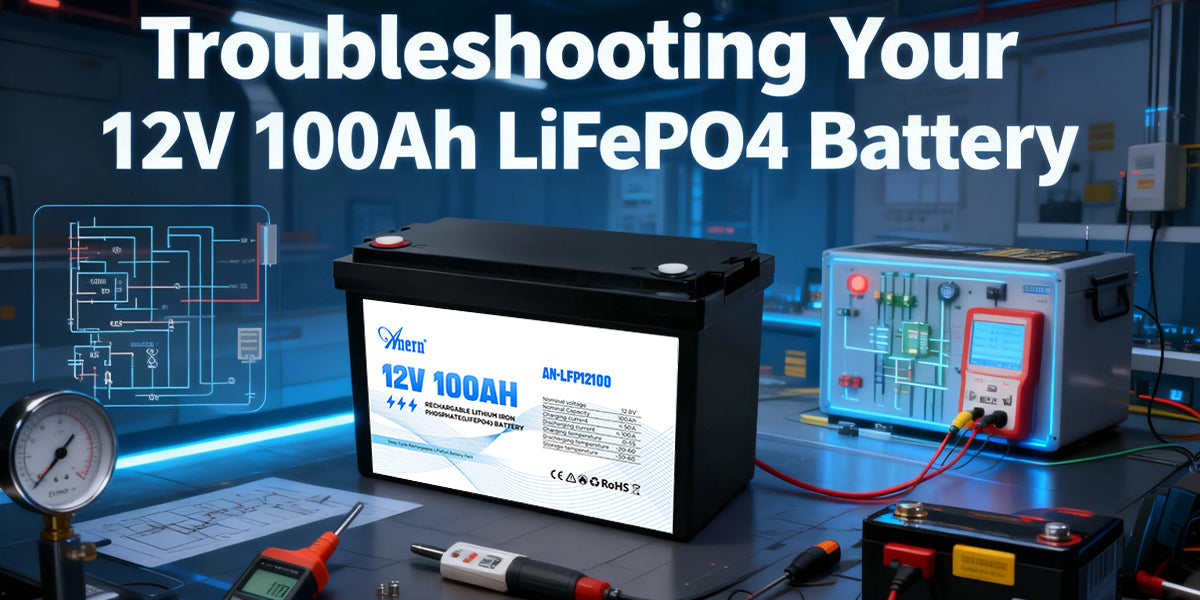
A sudden 0V reading on a 12V 100Ah LiFePO4 lithium battery can feel alarming. The good news is that 0V often points to BMS protection instead of cell failure. The same protection logic can also make a battery look “dead,” refuse a charger, or shut off the moment a heavy load kicks on.
A reliable fix comes from clear measurements and safe recovery steps. Once the root cause is removed, the battery usually returns to normal behavior fast.
Practical Check Before You Decide
Before applying this guidance, confirm your system voltage, expected daily energy use, continuous load, startup surge, battery chemistry, and local electrical requirements. For related Anern references and a non-commercial technical source, compare LiFePO4 BMS protection reset guide, BMS reset mistakes, NFPA electrical safety resources. This keeps the recommendation tied to real solar, battery, and inverter decisions rather than a one-size-fits-all rule.
Battery Safety Note
For BMS, 0V, or protection-mode issues, start with the least invasive checks: remove the load, connect a compatible lithium charger, and follow the battery manual. If the battery remains unresponsive, becomes hot, is swollen, smells unusual, or repeatedly trips protection, stop using it and contact the manufacturer or a qualified technician. Avoid bypassing protection or opening sealed battery packs unless the documentation specifically allows it.
Step 1: Prepare Tools and Stay Safe When Testing a 12V 100Ah LiFePO4 Lithium Battery
Safety makes every other step easier. LiFePO4 chemistry is stable, yet the current available from a 100Ah pack can still melt tools and damage wiring.
Tools You Need Prepare
- Digital multimeter (DC volts)
- A LiFePO4-compatible charger (preferred)
- Optional: bench power supply with current limit
- Insulated gloves and eye protection
- A small wrench or socket for terminal bolts
- Clean rag and contact cleaner for terminals
Safety Rules
- Remove rings, watches, necklaces, and loose metal.
- Keep metal tools away from both terminals at the same time.
- Work on a dry surface with good airflow.
- Stop immediately if the pack swells, vents, smells burnt, or heats at rest.
Cold-weather note: charging LiFePO4 batteries below 0°C (32°F) can cause lithium plating and permanent damage. Many BMS designs block charging in freezing conditions for that reason.
Step 2: Measure the Real Voltage to Diagnose 12V 100Ah LiFePO4 Battery Voltage Issues
Accurate voltage numbers reveal the real problem. Measure at the battery posts, not at a display screen or inverter panel.
Measure Voltage at the Battery Terminals
- Set the multimeter to DC Volts.
- Touch the red probe to the positive (+).
- Touch the black probe to the negative (−).
- Record the reading.
If the reading looks strange, repeat the test after tightening the terminal bolts.
Quick Reference: Typical 12V LiFePO4 Voltage Landmarks
Most 12V LiFePO4 batteries are a 4-cell series pack (4S) with a nominal system voltage near 12.8V.
| Battery State (Typical) | Voltage Range | What It Usually Means |
| Full charge zone | ~14.2V to 14.6V | Charger is topping off near max voltage |
| Normal resting | ~13.0V to 13.4V | Common mid-charge resting range |
| Low | ~11.0V to 12.0V | Approaching a low state of charge |
| Critical | ~10.0V to 11.0V | Near protection cutoff on many packs |
| Reads 0V | 0.0V | BMS may be open, or the wiring is disconnected |
Notes: Low-voltage cutoff thresholds vary by BMS design. Some packs disconnect higher than others. Always follow the spec for the exact battery model.
Check Voltage Under Load (A Hidden Source of Shutdowns)
A battery can look healthy at rest and still collapse under a surge load. This is one of the most common 12V 100Ah battery voltage issues in RV and inverter setups.
For a simple load test, keep the multimeter probes on the battery terminals and turn on a heavy load such as an inverter, compressor, or DC heater. Watch the voltage closely right as the load engages.
A brief dip is normal. A sharp drop followed by a shutdown usually points to loose terminals, corroded lugs, undersized cables, or a surge draw that trips BMS over-current protection. If the voltage at the battery stays stable while the inverter input voltage drops hard, cable loss is the real culprit.
Step 3: Identify the BMS Fault Trigger in Your 12V 100Ah LiFePO4 Lithium Battery
BMS protections can feel confusing until symptoms match the trigger. This is where LiFePO4 BMS troubleshooting becomes practical.
Common BMS Protections in 12V LiFePO4 Packs
- Low Voltage Cutoff (LVC): pack voltage fell too low, BMS opened the output
- Over-Voltage Protection: charge voltage exceeded safe limits
- Over-Current / Short Circuit: A surge draw or a wiring fault triggered a shutdown
- Temperature Protection: cold charge lockout or high-temp shutdown
Fast Symptom Map
| Symptom | Most Likely Cause | Best Next Action |
| 0V at terminals | BMS disconnected output, or a physical disconnect | Verify connections, then attempt safe wake-up |
| Charger shows voltage but 0A | BMS blocked charge, wrong settings, or cold pack | Check temperature and charger profile |
| Works on lights, fails on inverter | Surge draw or cable drop | Measure voltage under load at battery posts |
| Trips during charging near full | Over-voltage protection | Adjust the controller target voltage |

Step 4: Wake Up a “Sleeping” 12V 100Ah LiFePO4 Lithium Battery That Reads 0V
A “sleeping” pack often needs a controlled charge input so the BMS can reconnect.
Confirm the Basics First
Tighten the terminals, check fuses and disconnect switches, and confirm polarity on the charger clamps. A loose negative cable can mimic a dead battery perfectly.
Safe Wake-Up Method (Preferred)
Use a LiFePO4 charger connected directly to the battery posts. Select a LiFePO4 mode if the charger offers it, plug it in, and watch for a response. Keep all loads disconnected during recovery so the charger can work without interference. Many LFP systems charge up to about 14.6V at the top end. A charger set far below that may fail to “wake” some BMS designs, while a charger set too high can trigger over-voltage protection again.
Controlled Bench Power Supply Recovery (Only With Current Limit)
A bench supply can help when a standard charger will not engage, but current limiting is critical. Set the voltage between 13.8V and 14.4V, limit the current to a low level first for a gentle recovery, then watch the voltage climb gradually. If the pack warms up quickly, stop the attempt. Heat during low-current charging points leads to a deeper fault.
If Nothing Changes
Try a known-good LiFePO4 charger. Warm the battery above freezing if it sat in cold conditions, since below 0°C (32°F), many BMS units refuse charge. Recheck that you truly measured at the battery posts. A successful wake-up usually ends with the terminal voltage returning to a normal resting range and loads working again.
Step 5: Fix “Lithium Battery Not Charging” on a 12V 100Ah LiFePO4 Battery
When a battery will not accept a charge, the problem is usually configuration, temperature, or wiring.
Check Charger Output With a Multimeter
Measure the charger clamps directly. If the charger voltage is missing, the charger is the issue. If voltage is present but current stays at 0A, the BMS may be blocking charge.
Confirm Correct Charging Targets
For a typical 12.8V (4S) LiFePO4 pack, the max charge voltage is commonly around 14.6V. Many systems operate well with absorption targets in the 14.2V to 14.6V range, depending on the battery spec and controller behavior.
Eliminate Charger Modes That Cause Problems
Disable equalization mode, and avoid aggressive “repair” or “desulfation” modes designed for lead-acid batteries. Cable quality matters too, so keep connections tight and clean to avoid voltage drop and unstable charging.
Cold-Pack Charging Block
In winter, a charger can look normal while the battery refuses current. Temperature protection often explains that behavior. Charging below 0°C (32°F) is unsafe for LiFePO4 chemistry, so many BMS systems lock out charging until the cells warm up.
Why LiFePO4 Still Feels Like an Upgrade
A properly configured 12V 100Ah LiFePO4 lithium battery delivers stable voltage and strong usable energy for many daily applications. That stability is also why BMS protections matter. They prevent expensive damage when a system is misconfigured.
Step 6: Reset the BMS on a 12V 100Ah LiFePO4 Battery After Low Voltage Cutoff or Over-Voltage
A BMS reset usually works once the trigger condition is removed. Many people expect a button, but most packs use a “soft reset” pattern instead.
Soft Reset Routine
1. Disconnect all loads (inverter, DC panel, accessories).
2. Disconnect the charger.
3. Wait 2 to 5 minutes.
4. Connect the charger to the battery posts.
5. Allow the pack voltage to rise into a normal range.
6. Reconnect loads one at a time.
Fix the Cause Behind the Trip
If the LiFePO4 low-voltage cutoff happens, reduce parasitic drain during storage, raise the inverter’s low-voltage alarm settings, and recharge earlier instead of running the pack into the bottom range. If over-voltage protection happens, adjust absorption voltage closer to the battery spec, disable equalize, and watch alternator charging systems that can spike voltage.
Keep It From Coming Back
Keep charge voltage near the recommended LiFePO4 range, avoid charging below 0°C (32°F), tighten terminals after the first few cycles, use proper cable gauge for inverter loads, and store the battery at a moderate state of charge during long downtime.
Prevent Future 12V 100Ah LiFePO4 Battery Voltage Issues and BMS Trips
Reliable power comes from a stable battery and a stable system around it. A 12V 100Ah LiFePO4 lithium battery can handle demanding use, especially with a smart BMS monitoring voltage, current, and temperature. Most problems start when charger settings drift, connections loosen, or charging happens in freezing weather. Measure voltage at the battery posts, treat a 0V reading as a protection event, and keep charge targets near 14.6V. Avoid charging below 0°C (32°F). If recovery fails or heat appears during gentle charging, stop and seek professional testing.
FAQs
Q1: What fuse and breaker setup works best for a 12V 100Ah LiFePO4 battery system?
Place a fuse as close to the battery positive terminal as practical, ideally within 7–12 inches. Size it around 125% of your expected continuous current. High-surge inverters often benefit from Class T fusing and properly rated disconnect switches.
Q2: Can two 12V 100Ah LiFePO4 batteries be wired in series or parallel safely?
Yes, but match battery model, age, and state of charge before connecting. Use equal-length cables in parallel so the current is shared evenly. For series wiring, confirm the BMS supports series operation and keep charging limits aligned with the total system voltage.
Q3: Why does the “battery percentage” seem inaccurate on LiFePO4 systems?
LiFePO4 voltage stays relatively flat through much of the discharge cycle, so voltage-based gauges can jump around. A shunt-based monitor that counts amp-hours in and out delivers better accuracy, especially when loads change throughout the day.
Q4: What’s the best way to store a 12V 100Ah LiFePO4 lithium battery long-term?
Store it around 40% to 60% state of charge, often near 13.1V resting for many packs, then disconnect loads. Check voltage every 3–6 months. Recharge if it drops noticeably, keeping it away from freezing conditions and direct heat.
Q5: How can I verify capacity and health without special lab equipment?
Run a controlled discharge test at a steady load, then measure delivered amp-hours using a shunt meter. A 0.2C test rate is common, about 20A for a 100Ah battery. Compare results at similar temperatures for meaningful trends.
