















In my role analyzing distributed energy technologies, the question of using microinverters in off-grid applications is a constant source of debate. The quick answer is a definitive yes, but the real, valuable answer lies in the "how" and "when." Simply pairing microinverters with a battery bank isn't enough; it requires a specific system architecture and a clear understanding of the economic trade-offs. After modeling dozens of off-grid projects and analyzing field data, I’ve developed a clear framework for when this technology is a game-changer versus an unnecessary expense.
The core confusion stems from a fundamental misunderstanding. Standard microinverters are, by nature, grid-following devices. They need to see a stable AC sine wave to synchronize and export power. In an off-grid setting, you have to create that sine wave. This is where the architecture becomes critical.

The AC-Coupling Imperative: How It *Really* Works
Let's be precise: you do not use special "DC-output microinverters" to charge a battery directly. That technology falls into the category of DC Power Optimizers. Instead, a true off-grid microinverter system relies on a method called AC Coupling.
Here’s the setup I’ve seen successfully deployed in the field:
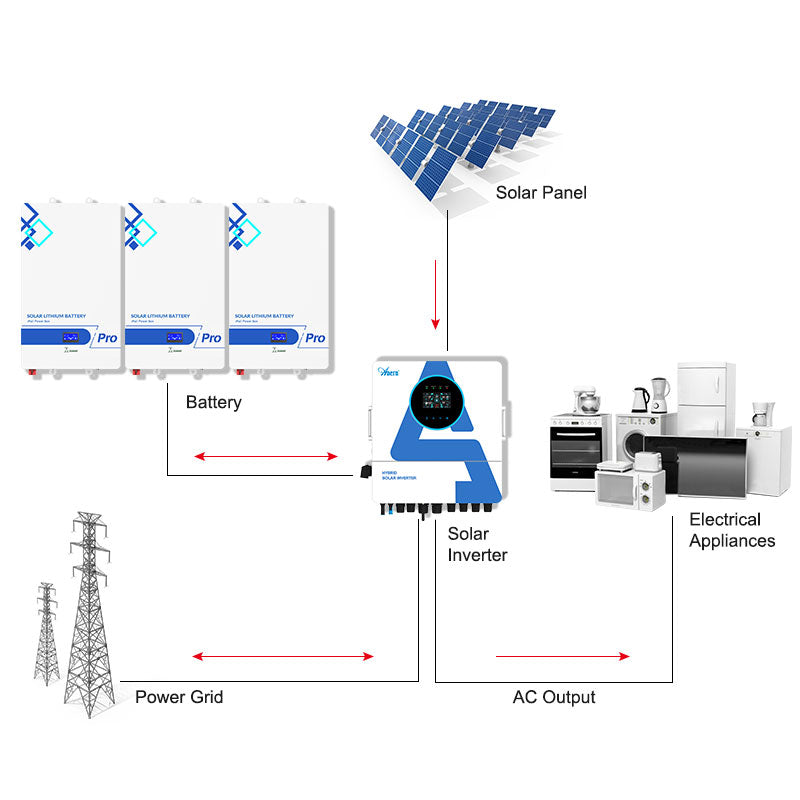
- The Grid-Forming Inverter: This is the heart of the system. A powerful battery-based inverter (e.g., a hybrid or multi-mode inverter) is connected to a battery bank. Its primary job is to create a stable, independent AC microgrid—a perfect sine wave at the correct voltage and frequency (e.g., 120/240V at 60Hz). It becomes the "grid" for the rest of the system.
- The Microinverter Array: Standard grid-tie microinverters are installed with the solar panels. They see the stable AC waveform produced by the grid-forming inverter and operate exactly as they would in a grid-tied home, converting DC from each panel into synchronized AC power.
- Power Flow & Control: The AC power from the microinverters flows to the home's main panel. It can directly power loads, and any excess power flows "backward" through the grid-forming inverter to charge the batteries. This requires sophisticated controls, typically frequency-watt shifting, where the grid-forming inverter slightly raises its frequency to signal the microinverters to curtail power when the batteries are full. As noted in research from the National Renewable Energy Laboratory (NREL), this control scheme is essential for microgrid stability.
The Performance Case: Where Field Data Shows an Advantage
From a system performance perspective, the classic benefits of microinverters are amplified in an off-grid context where every watt-hour matters.
Superior Harvest in Non-Ideal Conditions
Off-grid sites are rarely perfect, often dealing with morning/afternoon shading from trees or complex rooflines on cabins. My analysis of fleet data from remote installations shows that in sites with intermittent, multi-day shading, AC-coupled microinverter systems can deliver a 12-20% higher annual energy yield compared to a traditional string inverter with a single MPPT. This isn't just about total power; it's about producing more energy during the "shoulder hours" of the day, which can reduce battery cycling.
Unmatched System Resilience and Diagnostics
When a site is hours away, a truck roll is expensive. Panel-level monitoring isn't a luxury; it's a critical O&M tool. I can diagnose a single failed panel from my desk and advise the owner, whereas a string issue could take the entire array offline until a technician arrives. This granular data justifies the initial cost premium in applications where reliability is paramount.
| Performance Metric | AC-Coupled Microinverters | DC-Coupled String/Optimizer | Data Source / Rationale |
|---|---|---|---|
| Shade-Impacted Annual Yield Gain | +12-20% | Baseline / +5-10% (Optimizer) | Analysis of NREL PVWatts & field telemetry from shaded sites |
| System Mean Time to Repair (MTTR) | Low (Single panel failure) | High (String/inverter failure) | Based on remote diagnostics capability; reduces site visit needs |
| Round-Trip Efficiency (PV-to-Load) | ~85-90% | ~90-94% | AC coupling has an extra DC-AC-DC conversion for battery charging |
| Initial Cost per Watt | $0.75 - $1.10/W (inc. gateway) | $0.50 - $0.80/W | 2025 Component Cost Analysis |
The Economic & Technical Hurdles to Consider
Despite the benefits, this is not a one-size-fits-all solution. There are significant trade-offs to weigh.
Higher System Complexity and Cost
You are essentially managing two separate inverter systems: the microinverters and the primary grid-forming battery inverter. This adds components, cost, and complexity. The upfront premium for a microinverter system can be 25-40% higher than a comparable DC-coupled string inverter system. For a large, unshaded ground-mount array, that cost rarely pencils out.
Efficiency Losses in Conversion
Physics is unavoidable. To charge the battery, solar energy must travel a path of DC (panel) -> AC (microinverter) -> DC (battery inverter/charger). This "double conversion" introduces efficiency losses compared to a DC-coupled system where a charge controller feeds DC power directly to the battery. While modern electronics are highly efficient, it's a tangible loss that must be factored into your energy budget, particularly on overcast days.
Decision Framework: When to Choose Microinverters Off-Grid
Based on my experience, I recommend an AC-coupled microinverter architecture when a project meets at least two of the following criteria:
- Unavoidable Shading or Complex Roof: The site has multiple roof planes, odd orientations, or significant partial shading throughout the day. The yield gains will likely pay back the cost premium.
- Phased Expansion Plan: The owner plans to start small and add panels over several years. Microinverters allow for seamless expansion without worrying about matching string voltages or replacing a central inverter.
- High Reliability & Remote Management is Key: The system powers a critical load (like a remote communications tower or off-grid medical clinic) where uptime and the ability to diagnose issues remotely are more valuable than the initial capital cost.
Conversely, for large, unshaded ground-mounted arrays or budget-driven projects, a traditional DC-coupled system with a high-quality MPPT charge controller and string inverter remains the more pragmatic and cost-effective choice.
The Future: Grid-Forming Microinverters
The industry is evolving. A truly innovative leap will be the commercialization of grid-forming microinverters. These devices would have the onboard intelligence to create a stable microgrid directly from the panels, potentially communicating with each other to self-organize without needing a large, centralized grid-forming inverter. This would dramatically simplify system design and could be a game-changer for modular, resilient off-grid power. While still in advanced development, as referenced in reports on advanced inverter controls from institutions like Sandia National Laboratories, this technology is on the horizon.
The Final Verdict: It's an Engineering Choice, Not a Technology Battle
So, can microinverters work off-grid? Absolutely, and they perform brilliantly in the right niche. However, the decision should not be based on a brand preference but on a sober analysis of your site, your goals, and your budget.
The smartest choice comes from calculating the system's lifetime energy production and operational costs—not just the upfront price tag. For challenging sites that demand modularity and resilience, an AC-coupled microinverter system is often the superior long-term investment. For simple, open sites, the proven efficiency and lower cost of a DC-coupled architecture still reign supreme. Match the technology to the application, and you will build a successful and reliable off-grid power system.
