
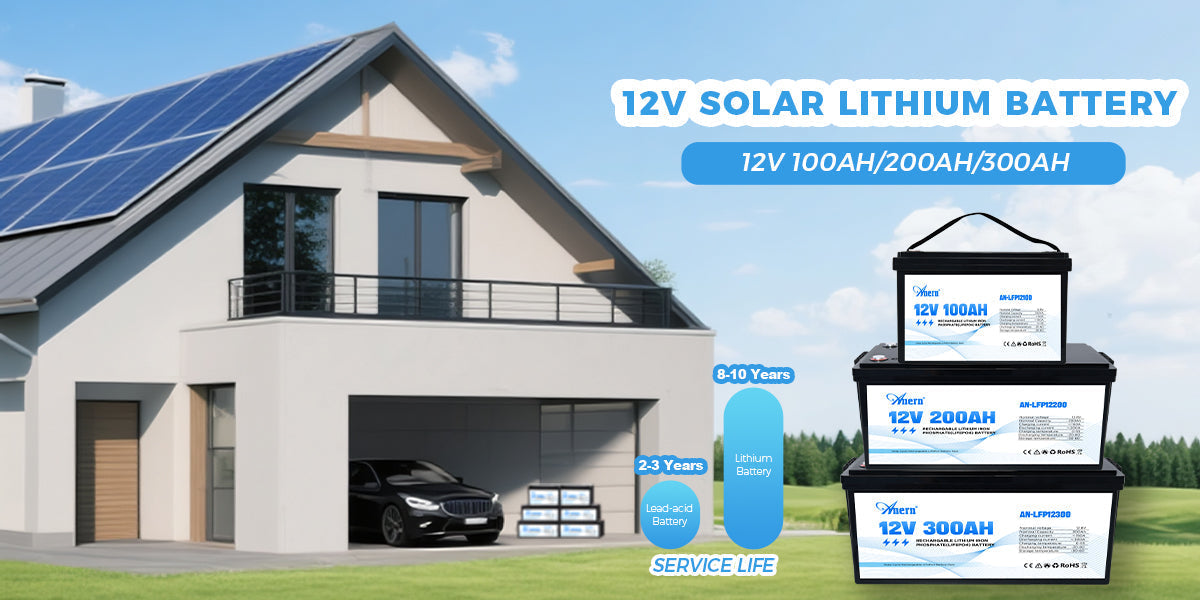
Many system designers still use 12 V architectures for small off-grid and backup projects. At modest power levels, this is manageable, but as loads grow, DC current, cable size, and protection limits quickly become constraints. If your projects already rely on a 12V LiFePO4 battery platform, building 24 V or 48 V banks from the same modules is a logical way to scale. The aim is to raise system voltage while keeping safety, serviceability, and long-term performance under control.
Why Use 12V LiFePO4 Batteries in 24V/48V Systems?
A 12 V building block remains common in DC power engineering because it is flexible, familiar, and easy to source. Many DC devices, relays, and protection components are designed around 12 V. Using 12V LiFePO4 batteries as the base unit lets you keep that ecosystem while delivering higher voltage banks for more demanding installations.
Advantages Over Lead-Acid
Compared with deep-cycle lead-acid, modern 12V lithium batteries built on LiFePO4 chemistry offer clear technical benefits:
- Higher usable capacity in daily cycling when operated within the recommended depth of discharge
- Longer cycle life under frequent charge and discharge conditions
- Lower mass and smaller footprint per kilowatt hour
- A flatter discharge curve that keeps the voltage more stable at the DC bus
When these modules are used to assemble 24 V or 48 V banks, they reduce structural load, simplify cabinet design, and help inverters operate within a tighter voltage window.
LiFePO4 as a Modular Building Block
Most 12V LiFePO4 modules have a nominal voltage close to 12.8 V and include an internal BMS. They can be combined into series strings to reach higher pack voltages. Some 12V LiFePO4 battery models are designed to support up to four units in series, so they can be combined into roughly 24 V or 48 V class systems when the datasheet confirms it. This allows OEMs and integrators to standardize on a single 12 V module type while serving multiple system voltage tiers.
24V Vs 48V: Which Voltage Should You Choose?
Choosing between 24 V and 48 V is a strategic decision. It affects current levels, cable sizing, inverter selection, and the scope of future upgrades.
Current and Cable Considerations
For a given power level, a higher DC voltage means a lower DC current. For example, a 2,400 W inverter draws:
- About 100 A from a 24 V bank
- About 50 A from a 48 V bank
Lower current reduces I²R losses and improves voltage stability during load transients. It also brings cable cross-section and connector sizing into a range that is easier to route in cabinets, enclosures, and vehicle frames.
Matching Existing and Planned Equipment
The installed base and future roadmap should guide the voltage level:
- Smaller standalone inverters and legacy DC loads are often 12 V or 24 V
- Higher power hybrid inverters and commercial ESS packages are frequently 48 V
- Some MPPT controllers support multiple bank voltages and can auto-detect the pack level
A 24 V bank can be appropriate for light commercial vehicles, small telecom sites, or compact off-grid systems. A 48 V bank often fits better for larger residential storage, light industrial loads, or higher power backup, where current handling is a concern.
How Many 12V LiFePO4 Batteries Do You Need?
Once the target voltage is fixed, capacity planning determines how many 12 V modules are required. Working in kilowatt hours keeps the design aligned with load profiles and autonomy targets.
Series Basics for 24V and 48V
At the pack level, series wiring is usually straightforward:
- A 24 V bank typically uses 2 × 12V LiFePO4 batteries in series
- A 48 V bank typically uses 4 × 12V LiFePO4 batteries in series
The maximum series count published by the battery manufacturer is critical. The internal BMS is rated for a specific total voltage, and that limit must not be exceeded.

Turning Energy Needs Into Amp Hours
Two simple relationships support the sizing process:
Energy (kWh) = System voltage (V) × Capacity (Ah) ÷ 1000
Capacity (Ah) = Required energy (kWh) × 1000 ÷ System voltage
Suppose a 24 V system should deliver about 2.5 kWh of usable energy per day. With a working depth of discharge set around 80 percent, the nominal bank energy becomes:
2.5 kWh ÷ 0.8 ≈ 3.1 kWh
The corresponding amp hours are:
3.1 × 1000 ÷ 24 ≈ 129 Ah
In practice, two 12.8 V 150 Ah LiFePO4 modules in series will meet that requirement with a margin for aging and short periods of elevated load.
Example Project Profiles
The table below gives indicative configurations for typical project types:
| Project Type | System Voltage | Example Bank | Approx. Energy (kWh) |
| Light commercial vehicle DC | 24 V | 2 × 12 V 100 Ah in series | ≈ 2.4 |
| Remote monitoring / telecom | 24 V | 2 × 12 V 200 Ah in series | ≈ 4.8 |
| Small commercial backup | 48 V | 4 × 12 V 200 Ah in series | ≈ 9.6 |
These are starting points. Each real project should still evaluate connected loads, daily run time, and required reserve days.
How to Wire 12V LiFePO4 Batteries Safely?
The quality of the physical layout often decides long-term system reliability. A repeatable wiring scheme with clear protection points is essential for B2B deployments.
Series and Parallel Layouts
In a series string, the positive terminal of one module connects to the negative terminal of the next module. The free negative at one end and the free positive at the other end form the main bank terminals. In parallel, all positives connect to a common positive busbar and all negatives to a negative busbar.
When several series strings are paralleled, each string should use its own pair of cables to the busbars so current sharing stays balanced. This reduces stress on individual 12V LiFePO4 batteries and simplifies diagnostics.
Busbars, Cables, and Terminations
Key practices for wiring:
- Use busbars with enough cross-section for the maximum continuous current
- Keep high-current cables short, mechanically protected, and well supported
- Use properly crimped lugs, torque terminals to the specified range, and document the layout for future service
A clean and labeled layout saves time during commissioning and troubleshooting, especially for integrators who support many identical systems.
Protection Devices
Protection is not optional in a professional installation. Typical protection points are:
- A fuse or breaker on each series string positive
- A main fuse or breaker at the bank output
- Branch protection for inverters, DC panels, and high surge loads
A DC disconnect switch for the full 12V LiFePO4 battery bank helps during maintenance and transport. Ratings for fuses and breakers should follow system current and any applicable local standards.
Which Chargers Work Best for 24V/48V LiFePO4 Banks?
Charging hardware must align with the chosen voltage and with LiFePO4 requirements. Correct settings protect cell health and reduce service calls.
MPPT Solar Charge Controllers
In PV-coupled projects, an MPPT controller links the array to the battery bank. Selection criteria include:
- Supported bank voltages and transition behavior between 24 V and 48 V
- Maximum PV input voltage and power rating
- Availability of LiFePO4 profiles or user-defined setpoints for bulk, absorption, and float
Charge voltages should follow the battery documentation. When several 12 V modules sit in series, the correct setpoint is the recommended per-module voltage multiplied by the number of units.
AC Chargers and Inverter-Chargers
Where grid or generator charging is required, the project may use a stand-alone charger or an inverter-charger. In both cases, it is important that:
- The DC output voltage matches the pack level
- The maximum charge current fits within the limits of the bank and upstream AC supply
- The charge curve can be tuned for LiFePO4 chemistry
Current limiting features are valuable for sites with constrained AC sources or shared supply lines.
Temperature and Low-Temperature Charging
LiFePO4 cells have a restricted charging temperature window. Some packs incorporate BMS logic that blocks charging at low temperatures, while others depend on external control. Monitoring actual cell temperature and avoiding charging below the specified minimum charge temperature is a simple way to extend bank life, especially in outdoor cabinets or unheated technical rooms.
Common Mistakes With 24V/48V LiFePO4 Systems
Field issues often trace back to a few recurring design choices. Avoiding them improves reliability across a whole fleet of installations.
Mixing Different Batteries in One Bank
Combining old and new modules, or mixing capacities within a single string, drives imbalance. Weaker units reach full charge or empty state earlier, and their BMS trips first. The effective energy of the bank then drops, even though some modules still have capacity. Keeping each bank built from matching 12V LiFePO4 batteries of the same type and age reduces this risk.
Undersized Cables and Hidden Voltage Drop
If cable sizing is based only on nominal current and ignores run length and ambient temperature, the voltage at the inverter input can sag under load. Typical symptoms are nuisance low-voltage alarms and warm cable jackets. Using a voltage drop calculation based on real cable paths and peak currents is a straightforward way to avoid this problem.
Relying Only on the Internal BMS
The BMS inside each module is designed to protect that module. It does not replace external fuses, breakers, and careful mechanical design. External shorts, damaged insulation, and incorrect connections can still create hazardous conditions. System-level protection is the layer that limits damage and keeps faults local and manageable.
Design a Reliable 24V/48V LiFePO4 System
A robust higher voltage DC system is the result of several aligned decisions. Define project loads and autonomy targets, choose 24 V or 48 V in line with cable runs and inverter class, then size the bank with realistic energy figures. Build the pack from 12V LiFePO4 batteries that are approved for series use, and respect any published limit on how many units can be placed in series to form 24 V or 48 V class systems. Combine that with clear wiring, documented protection schemes, and chargers configured for LiFePO4, and your teams can deploy repeatable DC power blocks that run quietly in the background while clients focus on their core operations.
FAQs
Q1. What certification should a 12V LiFePO4 battery pack meet for commercial projects?
For commercial or industrial deployments, look for packs tested to UN38.3 for transport plus cell/module standards such as IEC 62619 or UL 1973, and enclosures installed in line with local electrical codes. Always document ratings, fault currents, and protective device coordination.
Q2. How often should connections in a 24V/48V LiFePO4 bank be inspected?
Beyond initial commissioning, many integrators schedule visual and torque checks every 6–12 months, depending on duty cycle and environment. Inspection often includes terminal torque verification, signs of discoloration or corrosion, insulation condition, and optional thermal imaging under load to reveal hidden hot spots.
Q3. What kind of monitoring is recommended for higher voltage LiFePO4 systems?
Professional systems usually pair the internal BMS with a shunt-based meter or battery monitor plus data logging. Integration over CAN or Modbus into a site controller or SCADA allows alarms on voltage, current, temperature, state of charge, and unusual event counts, simplifying fleet maintenance.
Q4. Can a LiFePO4 bank be integrated with a generator or existing UPS?
Integration is possible when the inverter-charger or DC interface is sized correctly and configured for LiFePO4 limits. Coordination focuses on charge current, transfer logic, and start/stop thresholds so the generator or UPS sees stable DC conditions and short cycling of the engine or relays is avoided.
Q5. How should end-of-life and recycling be handled in project planning?
Project documentation should include expected service life windows, serial numbers of each 12V LiFePO4 battery, and designated recycling partners. Many regions require using certified recyclers, proof of proper disposal, and safe intermediate storage procedures if large packs are removed before replacement or system upgrades.
