
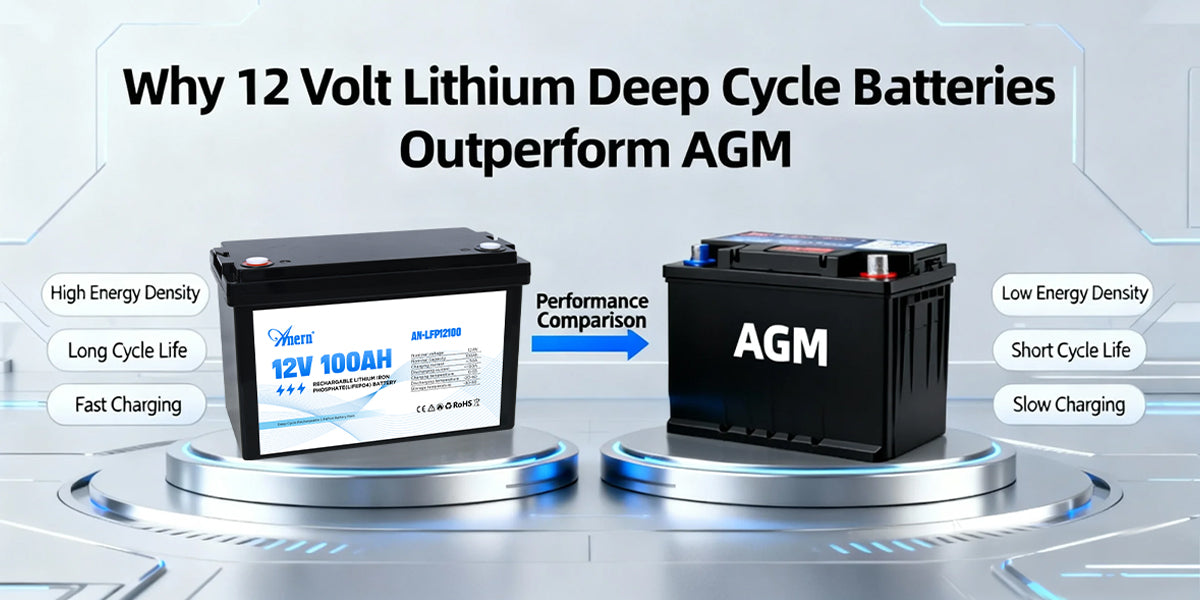
Battery choices show up in runtime, recharge time, and service tickets. In off-grid solar, mobile power, marine house banks, work trailers, and backup loads, the gap between lithium and AGM becomes obvious fast. A 12-volt lithium battery deep-cycle setup often delivers steadier voltage, higher usable capacity, and longer service life. Those gains can cut generator hours and reduce replacements.
AGM still fits certain jobs. Cold charging, float-heavy standby use, and strict upfront budgets can favor it. The key is matching the chemistry to duty cycle, charging conditions, and load profile.
What Makes a 12V Deep Cycle Battery Different?
A deep-cycle battery is built for repeated discharge and recharge. It is not designed for short engine cranking bursts.
Deep cycle performance depends on three basics:
- Depth of discharge: how far the battery is cycled each day
- Current draw: the load level during discharge and charge
- Time at partial state of charge: how long the battery sits below full charge
A 12V deep-cycle battery in daily cycling will age in a predictable way. High DoD and long time undercharging accelerate wear. Deep-cycle systems also need a stable voltage. Many loads depend on it. Inverters, DC compressors, pumps, and electronics all react to voltage drop.
How Does a 12 Volt Lithium Battery Deep Cycle Compare to AGM?
A clean comparison uses the same system goals, not the same label on the battery.
AGM is a sealed lead-acid design. It handles moderate cycling well. It charges in a familiar profile. It is also heavy for the energy stored. Voltage tends to fall as discharge progresses.
Most deep-cycle lithium in this class uses LiFePO4 chemistry. It pairs the cells with a BMS. It holds voltage flatter through much of the discharge window. It also accepts charges faster within the rated limits.
For many commercial builds, the practical difference shows up in three places:
- usable daily capacity
- recovery time after a workday
- replacement timing over a multi-year plan
That combination drives the long-term value case for a 12-volt lithium battery deep-cycle bank.
Why Does Lithium Deliver More Usable Capacity Than AGM?
Usable capacity is where planning errors happen. Nameplate amp hours do not guarantee daily amp hours.
AGM banks often get sized so that day-to-day cycling stays near mid-state of charge. Many operators target around 50% depth of discharge to protect life. Deeper daily cycles can work, yet service life usually drops faster.
LiFePO4 is commonly specified for deeper routine cycling. Many published specs rate cycle life at 70% to 90% DoD. That allows higher usable energy from the same rated capacity.
Practical Snapshot for a 100Ah Class Battery
Actual usable capacity varies by DoD targets, discharge rate, temperature, and system cutoffs.
| Metric | AGM Deep Cycle (Typical Planning) | LiFePO4 Deep Cycle (Typical Use) |
| Rated capacity | 100 Ah | 100 Ah |
| Common daily usable range | ~40–60 Ah | ~70–90 Ah |
| Daily result | Larger bank needed | A smaller bank can meet the same load |
That difference can reduce battery count, rack space, and cable complexity in many builds.
How Does Lithium vs AGM Compare on Cycle Life and Aging?
Cycle life drives replacement cadence. Replacement cadence drives downtime and labor.
AGM deep-cycle batteries can last well in light cycling. In heavier cycling, many data sheets show cycle life in the hundreds to low thousands, depending on depth of discharge, temperature, and charge quality. Premium deep-cycle AGM lines sometimes publish higher figures at moderate DoD.
LiFePO4 deep cycle specs often list cycle life in the low thousands at higher DoD. Many products publish 2,000 to 4,000 cycles at around 80% DoD, with higher counts at lower DoD. Those numbers still depend on heat and current levels.
Aging Triggers That Matter in the Field
For AGM
- time spent undercharged
- high heat
- repeated deep discharge without full recovery
For LiFePO4
- sustained high temperatures
- operation outside BMS limits
- charging below the allowed temperature range
The lifespan and performance of lithium vs AGM become most visible in daily cycling, short charge windows, and high load sites.
Why Does a Lithium Battery Upgrade Recharge Faster in Practice?
Recharge time is a scheduling problem. It affects fleet turnaround and generator planning.
AGM charging slows near the top. It spends longer in absorption. That behavior protects the battery. It also extends the time to full. Large AGM banks often use conservative charge rates to control heat and stress.
A lithium battery upgrade can shorten recovery time. LiFePO4 commonly accepts a higher charge current within specification. It also stays efficient deeper into the charge window. Many systems reach a high state of charge faster. That matters when charging depends on solar hours or limited generator runs.
What Faster Charging Changes Operationally
- solar harvest becomes easier to capture in midday peaks
- generator runtime can drop
- partial recharge days become less damaging than they are for lead acid
Charge equipment still matters. A charger profile set for AGM may not match lithium needs. Battery specs and BMS limits should drive the settings.

What Efficiency Differences Matter in Solar Backup and Off-Grid Systems?
Efficiency decides how much energy gets wasted as heat. It also affects fuel burn and solar array sizing.
The efficiency numbers below refer to battery-level DC round-trip efficiency. If you measure from AC-in to AC-out through an inverter and charger, system-level efficiency will be lower because conversion losses stack on top of the battery.
Lead acid round-trip efficiency often lands in the 70% to 85% range in real systems, depending on charge profile and state of charge. LiFePO4 systems commonly land around 90% to 95% under comparable conditions. Exact numbers change with measurement points and operating conditions.
Efficiency losses show up in two ways:
- An extra generation is required to refill the same usable energy
- extra time required to complete the charge cycle
In solar backup and off-grid systems, that translates to fewer generator hours and better use of short sun windows. It also supports smaller arrays for the same delivered load in some designs.
This is a major reason a 12-volt lithium battery deep-cycle bank often looks better on total cost of ownership, even with a higher initial cost.
What Load and Surge Performance Should You Expect From 12V Deep Cycle Batteries?
Load behavior affects inverter sizing and system stability.
AGM voltage tends to sag more under high current draw. That can trigger the inverter’s low-voltage alarms earlier. It can also reduce motor starting margin. DC loads may dim or reset as voltage drops.
LiFePO4 often holds voltage steadier through a large part of the discharge range. Many systems see fewer nuisance cutoffs. Loads feel more consistent.
Loads That Expose the Difference Fast
- inverter compressors and power tools
- pumps with start surges
- DC appliances with low-voltage protection
- mixed AC and DC use during peak demand
Cable sizing and connection quality still matter. High current at 12V is unforgiving. Poor lugs and long runs waste energy and create heat.
When Is AGM Still a Practical Alternative?
Some projects favor simplicity. Others favor cold performance. AGM can fit those needs.
AGM generally tolerates charging at lower temperatures than LiFePO4. Many LiFePO4 systems block charging near freezing to prevent cell damage. Some packs add heaters or controlled warming. Those features add cost and design work.
AGM can also make sense in float-heavy standby roles. Think alarm panels, light backup, or sites with rare discharge. In that profile, cycle life carries less weight.
AGM remains a practical AGM battery alternative when:
- Charging below freezing is routine, and heating is not feasible
- daily cycling is light
- the project timeline is short, and replacement planning is acceptable
Even then, many buyers still model lithium once service calls and runtime requirements are added.
A Quick TCO Check Without Using Prices
You can compare AGM and lithium using delivered energy instead of purchase price. This keeps the math clean for bids, distributors, and project sizing.
Define these variables:
- C = rated capacity (kWh)
- U = usable fraction per cycle (DoD target, as a decimal)
- E = round-trip efficiency (decimal)
- N = cycle life at that DoD (cycles to end-of-life capacity)
- L = lifetime delivered energy (kWh)
Then estimate:
L = C × U × E × N
If you want a “value per delivered kWh” metric without prices, compare two batteries by the ratio of their L values. Higher L means more delivered energy over service life at the same rated capacity class and operating assumptions.
Conclusion: Is It Worth Upgrading From AGM to Lithium
A clear answer comes from the duty cycle and operating conditions. Daily cycling pushes the math toward lithium. Short charge windows push it further. High peak loads also favor lithium due to voltage stability. In those cases, a 12-volt lithium battery deep-cycle setup can deliver higher usable energy per day, recover faster, and reduce replacement frequency.
AGM keeps its edge in cold charging and simple standby use. It also helps when the upfront cost is the only constraint.
For most solar and mobile power designs, the best deep-cycle battery for daily-cycling solar and mobile power systems tends to be LiFePO4 when the system cycles often and needs fast recovery. A quick screening helps:
- Cycle daily and rely on solar or generator windows: lithium usually fits best
- Charge in freezing conditions without heating: AGM often fits better
- Standby use with rare discharge: AGM can be fine
- High peak inverter loads: Lithium often reduces nuisance cutoffs
Before placing an order, align on the spec fields that prevent integration surprises: temperature limits, charge and discharge current limits, BMS cutoffs and recovery behavior, and cycle-life terms defined by DoD and end-of-life capacity.
FAQs
Q1. Do 12V LiFePO4 deep cycle batteries need ventilation like lead-acid?
Not for hydrogen gas control in normal operation. LiFePO4 does not vent like flooded lead-acid. Still allow airflow for heat, avoid tightly sealed boxes, and keep clearance around the case so the BMS and cells stay within spec.
Q2. What compliance documents should buyers request from suppliers?
Ask for UN 38.3 transport test summary, an SDS, and clear labeling. For safety compliance, request the applicable battery safety certification for your market, often UL 1973 in the U.S. or IEC 62619 internationally, plus any required shipping documentation.
Q3. Can you wire 12V lithium deep-cycle batteries in series or parallel?
Only if the manufacturer explicitly allows it. Use identical models with similar age and state of charge, match cable lengths, and fuse each string. In larger banks, prefer a busbar layout and verify BMS coordination for series stacking.
Q4. How should you store lithium deep-cycle batteries during seasonal downtime?
Store at roughly 30–60% state of charge in a cool, dry place. Disconnect parasitic loads, avoid long storage at 100% or near-empty, and check voltage every few months. Recharge gently if it drops below the supplier’s recommended floor.
Q5. What system protections reduce downtime when using lithium batteries?
Plan for BMS cutoffs. Add properly sized fusing, a main disconnect, and monitoring that alerts on low voltage or temperature lockouts. For critical loads, design a graceful shutdown sequence so controllers and networking gear do not reset unexpectedly.
