
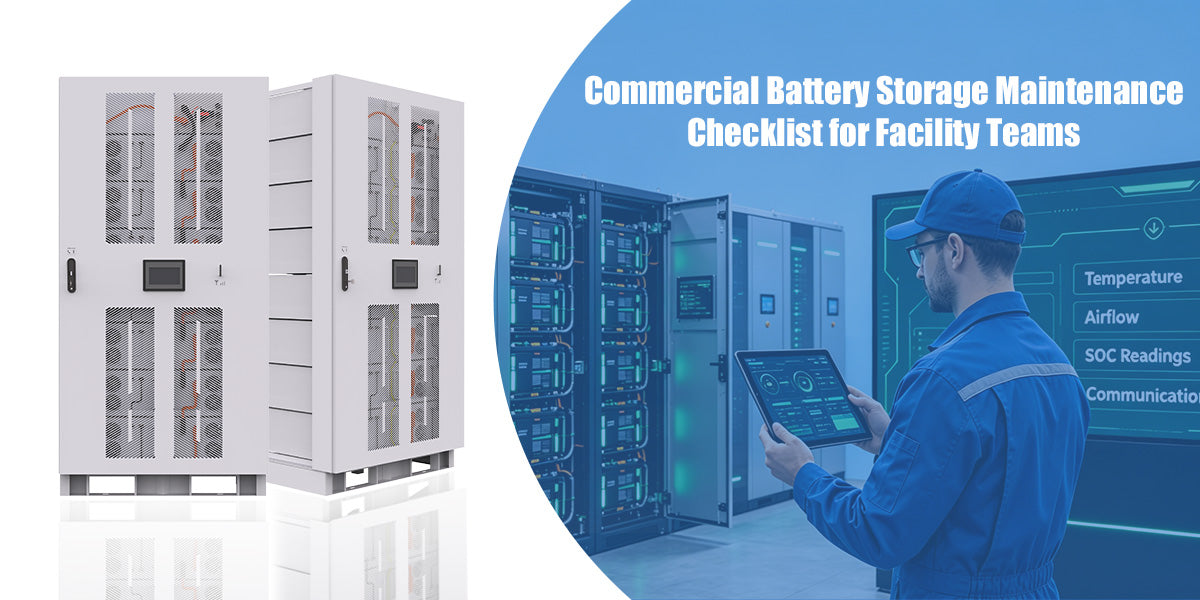
Commercial battery storage rarely fails without warning. Recurring alarms, rising cabinet temperatures, blocked airflow, unstable state-of-charge (SOC) readings, and communication faults typically appear long before larger problems occur. Establishing a clear preventive maintenance routine helps facility teams catch these early warning signals and keep energy storage solutions primed for optimal daily operation.
What Should Facility Teams Inspect in a Commercial Battery Storage System?
A commercial battery storage system (BESS) consists of several interconnected components. The Energy Market Authority’s ESS handbook describes a typical BESS as a holistic system featuring battery racks, a battery management system (BMS), a battery thermal management system, a power conversion system (PCS), and an energy management system (EMS). Facility teams must inspect the asset as one unified operating system.
Exterior Condition and Site Access
Inspect the equipment area during every routine walkdown. Ensure that cabinet doors, safety labels, warning signs, emergency access points, and service clearances remain highly visible. Promptly remove debris, leftover packaging, overgrown vegetation, standing water, and any objects obstructing critical ventilation paths.
Outdoor cabinets require closer scrutiny following heavy rain, flooding, extreme heat, high winds, dust storms, pest activity, or nearby construction. Look for dented panels, loose fasteners, degraded weather seals, structural corrosion, water ingress marks, and signs of tampering. A compromised cabinet can expose sensitive electronics to damaging moisture and dust.
Alarms, Status, and Operating Mode
Regularly review the Human-Machine Interface (HMI), EMS screen, or remote monitoring portal. Confirm the system is online and functioning properly. Check active alarms, cleared alarms, SOC, available capacity, current operating mode, power output, battery temperatures, PCS status, and communication network health.
Successful energy storage solutions rely heavily on high-quality monitoring. However, a green dashboard does not replace a physical inspection, just as a clean cabinet exterior does not replace a thorough alarm review.
Battery, Inverter, Cooling, and Communication Checks That Matter Most
Every subsystem plays a defined role: batteries store energy, the BMS supervises individual cells, the PCS manages power conversion, cooling mechanisms keep temperatures within allowed ranges, and communications enable the EMS, BMS, PCS, meters, and site controllers to work in tandem.
Battery and BMS Checks
Battery energy storage systems contain extremely hazardous high-voltage DC equipment. Facility teams must strictly adhere to tasks approved by the operations and maintenance (O&M) manual and site safety procedures. Visual checks, dashboard reviews, and alarm reporting are usually the safest tasks for facility staff.
During inspections, immediately note abnormal odors, smoke, visible fluid leakage, cabinet swelling, damaged cabling, corrosion, active warning lights, or water ingress. Check BMS alarms for cell voltage deviations, temperature extremes, insulation faults, contactor failures, abnormal currents, or a sudden loss of communication.
The BMS tracks voltage, current, temperature, state of charge (SOC), and state of health (SOH). These metrics help teams verify normal operation. Repeated alarms demand a professional service review, and rising temperatures under normal load conditions often signal cooling or airflow failures.
PCS and Inverter Checks
Many commercial teams use the term "inverter" to describe the equipment connecting the battery to the facility's AC infrastructure. For larger systems, PCS is the more accurate terminology because it facilitates bidirectional power conversion.
Inspect the PCS area for active faults, unusual cooling fan noises, blocked air filters, damaged conduits, excessive dust buildup, heat discoloration, and moisture. Review fault logs associated with AC voltage, DC voltage, grid synchronization, insulation resistance, frequency, temperature spikes, and communication drops.
Avoid relying on repeated system resets as a routine fix. While a reset may clear an error on the screen, it often masks a loose terminal, clogged filter, grounding fault, cooling issue, or control error. Reliable energy storage solutions demand thorough root-cause analysis.
Cooling and Thermal Management Checks
Effective thermal management protects battery performance and maximizes service life. Air-cooled systems require unobstructed vents, functioning fans, clean filters, and appropriate ambient room conditions. Liquid-cooled systems require monitoring of cooling alarms, pump activity, coolant temperatures, fluid pressures, and visual inspections for hose or fitting leaks.
Facility teams should never open closed cooling loops or service refrigerant lines without proper authorization. However, they provide immense value by reporting cabinet temperature trends, blocked airflow, fluid stains near equipment, and recurring cooling alarms.
Communication and Control Checks
Commercial energy storage systems rely on clean data exchange. The EMS, BMS, PCS, utility meters, fire system interfaces, and site controllers require rock-solid communication stability. Missing data can instantly disrupt peak shaving, backup reserve allocation, solar self-consumption, demand response programs, and financial reporting.
Routinely check for offline devices, delayed meter readings, inconsistent timestamps, data gaps, and repeated communication faults. Verify that critical alarm notifications are successfully reaching the designated on-call team.
How Often Should Commercial Energy Storage Systems Be Maintained?
Maintenance frequency must adhere to the manufacturer’s O&M manual, warranty stipulations, local electrical codes, site environmental conditions, typical duty cycles, and overall risk profiles. Because system requirements and service contracts vary widely, following a standardized O&M framework ensures consistency.
The table below provides a foundational planning structure for facility teams. It should be tailored to match specific equipment guidelines and site procedures.
| Interval | Facility Team Tasks | Qualified Service Tasks |
|---|---|---|
| Daily or per shift | Check dashboard status, active alarms, SOC, operating mode, and backup reserve levels. | Support urgent alarm reviews if immediately required. |
| Weekly | Inspect enclosure conditions, clearances, ventilation paths, access routes, and network status. | Review recurring warnings and minor fault logs. |
| Monthly | Review alarm trends, temperature averages, energy throughput, and open service tickets. | Check filters, run diagnostics, and perform service items permitted by the manual. |
| Quarterly or semiannually | Review logbooks, spare parts inventory, emergency contacts, and staff responsibilities. | Inspect the PCS, thermal systems, protection devices, and dispatch settings. |
| Annually | Review performance summaries, training records, site documentation, and emergency readiness. | Complete formal preventive maintenance and functional testing as specified by the manufacturer. |
Sites experiencing heavy daily cycling may require significantly shorter maintenance intervals. Hot, dusty, humid, coastal, or flood-prone locations demand extra inspections and specialized cleaning. Facilities utilizing battery energy storage primarily for backup power should stringently verify reserve settings before severe storm seasons or planned grid outages.
Warning Signs That May Indicate Performance or Safety Issues
A well-maintained system behaves predictably. Warning signs typically manifest as repeated alarms, shifting performance trends, or anomalies observed in the field. Facility teams must treat these signs as immediate service triggers, particularly when they involve temperature fluctuations, electrical protection trips, water ingress, or fire detection mechanisms.
Escalation Triggers
Immediately escalate the issue following site emergency procedures if any of the following occur:
- Smoke, fire, burning odors, popping sounds, hissing noises, or visible gas releases.
- Triggered fire detection, gas detection, or a thermal runaway warning.
- Water ingress, standing water near high-voltage equipment, or unexplained fluid leaks.
- A persistent overtemperature alarm or highly uneven cabinet temperatures.
- Insulation faults, ground faults, contactor failures, or critical high-voltage warnings.
- Repeated PCS trips or shutdowns under seemingly normal operating conditions.
- Structural damage to cabinet doors, broken weather seals, aggressive corrosion, or severed cables.
- Communication losses that affect automated dispatch, alarm routing, or backup readiness.
- Unexpected capacity reductions or failures to fully charge under normal settings.
Emergency alarms dictate immediate activation of the site emergency plan. Keep personnel far away from the equipment if conditions appear unsafe. Contact the responsible service provider, safety lead, or emergency responders exactly as dictated by the facility's safety protocols.
Performance Warning Signs
Performance degradation often develops gradually. Watch for reduced available capacity, unusually high standby energy losses, frequent power derating, unstable SOC readings, delayed discharge responses, failed charging schedules, and poor output during peak demand events.
BESS performance should be continuously evaluated against the site’s intended use pattern. For example, a peak-shaving site suffers direct financial losses through missed discharge windows, while a backup-focused site is at risk if reserve settings inadvertently drift below the required operating plan.

Documentation and Monitoring Practices for Long-Term Operation
Rigorous documentation serves as the memory of a maintenance program. It protects the business when navigating complex questions regarding warranties, performance guarantees, safety training compliance, or service response times.
Records to Keep Current
Maintain a secure, digitally controlled storage file for the site. This should include exact equipment models, serial numbers, original commissioning records, updated single-line diagrams, comprehensive O&M manuals, exact warranty terms, active permits, historical inspection reports, resolved service tickets, firmware version histories, spare parts logs, and up-to-date emergency contacts.
Training records must explicitly document which staff members are authorized to perform visual checks, acknowledge alarms, contact the primary service provider, and initiate emergency shutdowns.
Maintenance Log Fields
A highly functional maintenance log supports both daily operations and deeper service reviews.
| Log Field | Purpose |
|---|---|
| Date and time | Identifies exactly when the condition was observed. |
| Inspector name | Creates a clear chain of accountability. |
| System status | Records whether the system is online, in standby, charging, discharging, or faulted. |
| SOC and available energy | Supports operational readiness reviews. |
| Active alarm code | Assists the service team in rapidly diagnosing technical issues. |
| Cabinet temperature | Tracks crucial thermal management trends over time. |
| PCS status | Indicates the health of the conversion-side infrastructure. |
| Visible condition | Captures physical notes on leaks, damage, corrosion, blockages, or water marks. |
| Action taken | Records whether a reset, escalation, cleaning, or access restriction occurred. |
| Owner and due date | Prevents unresolved open items from being forgotten or ignored. |
Monitoring Metrics That Support Business Decisions
System monitoring should emphasize actionable metrics. Key indicators include overall system availability, active vs. cleared alarms, SOC, SOH, instantaneous charge/discharge power, cumulative energy throughput, cabinet temperatures, PCS temperatures, communication network uptime, cooling system status, and backup reserve levels.
These organized records ensure that facility managers, energy engineers, finance teams, and external service partners communicate using the same factual data. Robust monitoring significantly improves future strategic planning for energy storage expansions and site resilience upgrades.
Regular Maintenance Keeps Commercial Energy Storage Solutions Ready for Daily Use
A routine maintenance program thrives when every task is assigned a clear owner. Facility teams can easily manage daily walkdowns, dashboard audits, logging, and issue escalation. Meanwhile, authorized technicians handle internal electrical diagnostics, coolant fluid services, major firmware updates, relay protection checks, and rigorous functional testing.
Commercial energy storage solutions are instrumental in supporting peak load management, backup power planning, solar PV integration, and facility energy cost control. Achieving these benefits relies entirely on system availability. Clear, actionable routines empower teams to inspect cabinets, audit alarms, track thermal trends, record corrective actions, and escalate high-risk warning signs long before they disrupt daily operations.
Ultimately, consistent and diligent maintenance provides facility and energy management teams with a highly accurate view of long-term performance across their entire portfolio of energy storage assets.
FAQs About Commercial Battery Storage Maintenance
Q1. Does commercial battery storage require a commissioning baseline?
Yes. A formalized commissioning baseline is essential. It allows facility teams to accurately compare future performance against the system's pristine, day-one operating conditions. This baseline must document usable capacity, response latency, alarm thresholds, control modes, baseline efficiency, network communication setups, and the approved operating limits established during the project handover.
Q2. Are firmware updates considered part of battery storage maintenance?
Yes. Firmware updates must follow a highly controlled change process. Facility teams should always secure vendor approval, log backup current settings before updating, schedule planned downtime, document the exact version history, and meticulously verify system behavior after the update is applied. Unapproved or poorly executed firmware changes can severely impact automated controls, alarm logic, and warranty validity.
Q3. How can seasonal load changes affect battery storage operation?
Seasonal shifts—such as summer HVAC peaks, winter storm risks, and fluctuating solar generation—drastically alter daily battery cycling. Facility and energy teams must proactively review charging schedules, adjust backup reserve parameters, and redefine demand management targets prior to entering high-load seasons. This proactive adjustment ensures the storage operation aligns perfectly with actual, real-time site needs.
Q4. Should battery storage be included in facility emergency response planning?
Absolutely. Commercial BESS installations must be fully integrated into the facility’s overarching emergency response plan. This plan should clearly identify safe access points, electrical isolation procedures, specialized emergency contacts, restricted hazardous areas, alarm notification routing, and responder coordination protocols. On-site staff must know exactly whom to call before ever approaching potentially unsafe high-voltage equipment.
Q5. What should facilities plan for as battery storage systems age?
As systems mature, facilities must budget and plan for comprehensive capacity testing, cell degradation reviews, shifting spare parts availability, critical warranty milestones, potential capacity augmentation, and eventual end-of-life recycling. System aging does not equate to immediate replacement; rather, it necessitates refined performance expectations and a strategic capital budget plan for future asset management decisions.
