
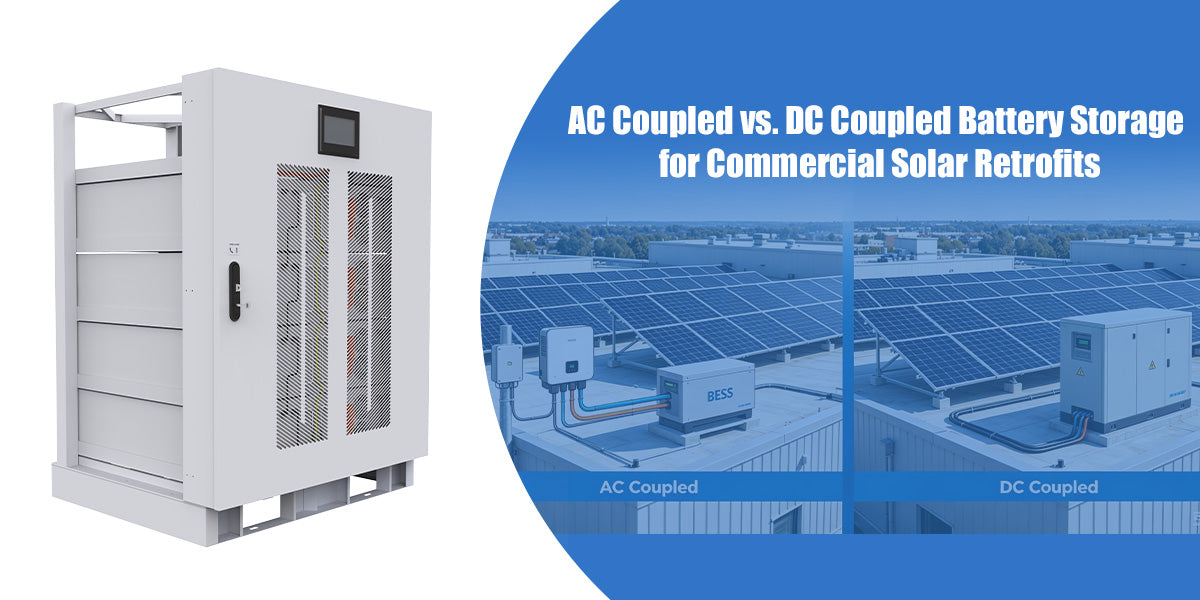
Many commercial PV systems were installed before battery storage became a practical upgrade for demand control, backup support, and higher solar self-consumption. Today, the challenge lies in adding storage without requiring an unnecessary PV redesign, facing utility-review delays, or enduring long outage windows.
For EPC teams, facility owners, distributors, and project developers, the coupling method directly impacts inverter selection, conversion losses, metering, protection settings, grid approval, and future system expansion. A robust solar battery storage plan must align with the site's existing electrical layout and the primary business objective for adding storage. Furthermore, it should ensure that all storage decisions remain grounded in real-world operating data.
How AC-Coupled and DC-Coupled Storage Connect to Commercial Solar Systems
The coupling method defines where the battery energy storage system electrically connects within a PV project. It does not describe battery chemistry. Instead, it details the electrical pathway between the PV array, inverters, battery system, facility loads, and grid connection.
Solar modules produce direct current (DC), and batteries store DC power. However, most commercial buildings and utility grids rely on alternating current (AC). Power conversion equipment serves as the bridge between these two sides. The U.S. Department of Energy classifies co-located PV and battery storage as either AC-coupled or DC-coupled based entirely on how the battery interfaces with the PV system.
AC-Coupled Storage
In an AC-coupled system, the PV infrastructure and the battery system converge on the AC side. The solar array sends DC power to the PV inverter, which then converts it to AC. That AC power can serve building loads, export to the utility grid, or be routed through a battery inverter for charging.
The standard path flows from the PV array to the PV inverter, to the AC switchboard, and finally to the battery inverter (or PCS) and battery system. This layout allows the existing PV system and the new battery installation to operate as separate assets on the site’s AC infrastructure. This inherent separation is the primary reason why AC coupling is so prevalent in commercial solar battery storage retrofits.
DC-Coupled Storage
In a DC-coupled system, the battery connects directly on the DC side. The PV array and the battery typically share a DC bus, a DC-DC conversion stage, charge control equipment, or a hybrid inverter. This setup allows solar power to charge the battery before passing through the inverter to become AC power.
This layout can reduce conversion steps when solar energy is used to charge the battery first and serve site loads later. It can also recapture a portion of the PV energy that might otherwise be lost to inverter clipping in certain high DC-to-AC designs.
Why AC-Coupled Battery Storage Is Often Used for Retrofit Projects
Retrofit projects are defined by fixed conditions from day one. PV modules, inverter types, string designs, interconnection documents, switchgear, and protection settings are often already approved and operational. A storage upgrade must seamlessly integrate into these conditions to deliver value.
AC-coupled solar battery storage is typically the best fit for this environment because the battery system attaches to the AC side, allowing the existing PV inverter to remain in active service. The design team can size the PCS, transformer, battery inverter, protection equipment, and controls around the current electrical ecosystem.
This approach significantly minimizes DC-side redesigns and limits construction disruptions. For a factory, cold storage facility, retail site, logistics center, or industrial park, minimizing downtime through smart outage planning can be just as crucial as the equipment cost itself.
Practical Advantages for Existing PV Sites
AC coupling is frequently the first choice when a commercial project needs to retain functioning PV inverters, connect storage near the main AC switchboard, expand capacity in phases, implement demand charge management, or facilitate controlled grid charging in compliance with utility regulations.
For many commercial clients, integrating battery storage with solar power is driven by tariff management. A battery might discharge to shave short demand peaks or shift midday solar generation into late afternoon and evening operations. NREL research on commercial solar-plus-storage emphasizes that the financial value of demand reduction varies drastically based on the customer, building type, location, system size, and specific tariff structure.
Retrofit Constraints That Require Early Review
Despite its flexibility, AC coupling requires meticulous engineering. The main service entrance may lack adequate spare capacity. Transformers must be carefully reviewed, and export limits might shift once storage is introduced. Furthermore, protection settings and anti-islanding functions require precise coordination.
The existing PV inverter also warrants careful attention. Its age, warranty status, communication capabilities, fault history, and ongoing service support will heavily influence the overall retrofit strategy.
When DC-Coupled Storage Makes More Sense for New Solar Projects
New construction projects afford engineers complete control over the full electrical architecture. PV capacity, battery size, inverter power, cable routing, protection equipment, metering, EMS logic, and the point of interconnection can be cohesively planned from the ground up.
DC-coupled solar battery storage is highly advantageous when PV and storage are engineered under a single scope. The battery can charge directly from the PV array, utilizing shared conversion equipment. Additionally, this design optimizes the capture of DC-side solar production during peak hours when output exceeds the inverter’s AC rating.
A Stronger Fit for Integrated Solar-Plus-Storage Designs
DC coupling should be prioritized when a project features combined new PV and storage, aggressive PV self-consumption targets, a high DC-to-AC ratio, limited AC-side expansion space, or specific microgrid, weak-grid, and off-grid operational requirements.
In highly saturated sunlight, a PV array can generate DC power that surpasses the inverter’s AC output limit, causing the excess power to be "clipped." A DC-coupled battery can intercept and store this excess energy before clipping occurs. The economic value of this feature depends on PV sizing, local solar irradiance, battery power, storage duration, state-of-charge limits, and intelligent dispatch controls.
Why DC Coupling Can Be Harder in Retrofits
Integrating on the DC side of an existing commercial PV plant is notoriously complex. The battery design must perfectly match existing voltage windows, string configurations, combiner equipment, inverter limits, isolation requirements, and safety protocols. Furthermore, replacing a fully functional PV inverter can drastically alter the project's financial return.
DC coupling is generally considered during a major site repowering or if the existing PV inverter is nearing the end of its functional lifespan. For a standard battery addition, AC coupling remains the path of least resistance.

Efficiency, Installation Cost, and System Flexibility Compared
Efficiency and cost should be evaluated by tracing the actual energy path. Solar energy can flow straight to facility loads, charge the battery first, or allow the battery to charge from the grid. Each unique pathway involves different conversion losses, hardware requirements, and control strategies.
Efficiency
DC coupling enhances the solar-to-battery pathway because both the PV and the battery operate in DC. Eliminating intermediate conversion steps significantly reduces energy loss when solar power is stored prior to consumption.
Conversely, AC coupling introduces extra conversion steps for solar charging. The PV inverter converts solar DC into AC. The battery inverter then rectifies that AC back into DC to charge the battery. During discharge, the DC must be inverted back to AC for the building or grid.
The cumulative annual impact of these losses depends entirely on system dispatch. A comprehensive solar battery storage study must model annual energy flows, charging sources, discharge timing, and strict reserve settings.
Installation Cost
Because they can share conversion hardware, DC coupling can eliminate duplicated equipment costs in new solar-plus-storage projects. AC coupling typically requires separate, dedicated PV and battery inverters. However, in a retrofit scenario, adding a separate battery inverter is almost always cheaper than redesigning the entire DC architecture or replacing functional PV inverters.
An accurate cost comparison must account for engineering, permitting, labor, outage downtime, commissioning, protection studies, utility reviews, and long-term service accessibility.
System Flexibility
AC coupling offers commercial retrofits superior expansion flexibility. The PV system and the battery storage system can be scaled independently of one another. While DC coupling provides a beautifully integrated architecture for brand-new builds, any future expansion must remain strictly compatible with the shared DC bus, existing inverter capacity, voltage limits, and unified control strategy.
| Factor | AC-Coupled Storage | DC-Coupled Storage |
|---|---|---|
| Common Project Fit | Existing commercial PV retrofits | New solar-plus-storage projects |
| Main Advantage | Retrofit flexibility and independent scaling | Highly integrated energy pathway |
| Solar-To-Battery Path | Involves extra conversion steps (DC-AC-DC) | Requires fewer conversion steps (DC-DC) |
| System Expansion | Often easier to execute in phases | Requires rigorous DC-side compatibility reviews |
| Clipping Recovery | Highly limited | Achievable in suitable high DC-to-AC ratio designs |
Grid Connection and Inverter Compatibility Questions to Ask Early
Local utility regulations and the facility's existing electrical infrastructure ultimately dictate what is possible. The chosen coupling method will deeply affect interconnection reviews, metering setups, export controls, relay settings, and final commissioning. These variables must be resolved long before equipment procurement begins.
Key Questions for Commercial Retrofit Planning
A project team must gather answers to the following operational questions immediately:
- What specific PV inverter models are currently installed, and what is their operational age?
- Does the current interconnection agreement legally permit battery energy export?
- Is the battery authorized to charge from the utility grid?
- Where can the PCS or battery inverter connect safely without overloading circuits?
- Does the main switchboard have adequate physical space and electrical bus capacity?
- Must the site transformer be evaluated for new charging and discharging thermal profiles?
- Which critical facility loads require dedicated backup power?
- What physical metering is required for PV generation, battery charging, and discharging?
- Will the EMS govern export limits, peak shaving, backup reserves, or TOU dispatching?
The answers will clarify whether the project's primary bottleneck lies on the PV side, the AC service entrance, the control logic, or the utility interconnection agreement.
Pre-Engineering Inputs to Collect
Storage sizing must be grounded in granular site data, not merely on the rated PV capacity or a generalized target battery size. Before sizing a solar battery system, engineers must compile 12 months of interval load data, historical utility bills, comprehensive tariff details, PV production logs, an accurate single-line diagram, inverter specifications, switchboard ratings, transformer limits, available footprint dimensions, backup load prioritization, export-limit documentation, and long-term expansion goals.
Collecting these inputs prevents costly oversizing, undersizing, and inaccurate dispatch assumptions. It also ensures that EPCs, consultants, distributors, and procurement teams compare battery architectures on an identical technical foundation.
The Right Coupling Method Helps Commercial Solar Storage Fit the Project
The ultimate coupling decision must reflect the site’s physical realities, utility constraints, and the owner’s primary revenue or resilience goals. A healthy, operating PV system almost always points toward AC-coupled solar battery storage. Conversely, a newly engineered PV-plus-storage project strongly favors DC coupling. A major inverter replacement event is often the only time a retrofit justifies a full comparison of both options.
Retrofit Decision Matrix
| Site Condition | Likely Direction to Evaluate |
|---|---|
| Existing PV inverters are healthy and under warranty | Evaluate AC coupling first |
| PV inverters are nearing the end of their service life | Compare AC retrofits against full DC redesigns |
| New PV and BESS are being built simultaneously | Evaluate DC coupling early in the design phase |
| The project requires phased storage expansion over time | AC coupling generally offers superior flexibility |
| The site operates with a high DC-to-AC ratio | Review DC coupling to maximize clipping recovery |
| Utility battery export is heavily restricted | Prioritize EMS, metering, and tight control reviews |
| Uninterrupted backup power is mandatory | Review critical load separation and automated transfer designs |
Common Mistakes to Avoid
Commercial development teams can drastically reduce project risks by avoiding these frequent errors:
- Sizing the battery by kWh capacity alone, without considering power delivery.
- Ignoring the PCS power rating and its impact on maximum discharge duration.
- Assuming that an existing PV interconnection approval automatically covers battery exports.
- Overlooking physical switchgear space and thermal transformer capacity.
- Treating backup power resilience and financial bill savings as the exact same design goal.
- Comparing system efficiencies without modeling the actual, real-world dispatch profile.
- Selecting and purchasing equipment prior to completing a thorough utility rule review.
A project aimed at demand-charge reduction, a project requiring backup power, and a project focused on PV self-consumption all demand entirely different PCS sizing, reserve thresholds, and EMS logic. Procurement teams must firmly establish the coupling method before they begin comparing battery cabinets, transformer needs, switchgear alterations, and software monitoring functions.
Commercial solar retrofits are most successful when the electrical design closely follows real site conditions. The optimal solar battery storage architecture will seamlessly protect existing assets, satisfy all grid requirements, facilitate future expansions, and provide the facility owner with a storage system that perfectly executes their operational strategy.
FAQs About Commercial Battery Storage
Q1. Can battery chemistry affect the coupling method?
No. Battery chemistry and the coupling architecture are entirely separate engineering decisions. LiFePO4, NMC, and other battery chemistries can function flawlessly in either AC-coupled or DC-coupled systems, provided that the voltage ranges, BMS communications, PCS compatibility, thermal controls, and safety parameters are correctly aligned.
Q2. How long should a commercial battery discharge?
Discharge duration is dictated by the site's primary financial or operational goal. A short-duration system (1–2 hours) is typically sufficient for managing sharp demand peaks. A longer-duration system (4+ hours) is necessary to support critical backup loads or execute time-of-use energy shifting. Engineers must model load intervals, utility tariff windows, operating hours, and reserve requirements before finalizing a duration requirement.
Q3. Can a solar battery system reduce backup generator runtime?
Yes, depending on the system's design. Battery storage can instantly support critical loads during brief outages, eliminate unnecessary generator start-ups, and smooth out generator load profiles. The ultimate success of this strategy depends on the automatic transfer equipment, integrated generator controls, the battery's peak power rating, load prioritization, and local electrical safety codes.
Q4. Who should approve the final storage architecture?
The final system architecture must be formally reviewed and approved by the electrical engineer of record, the local utility representative, the Authority Having Jurisdiction (AHJ), the EPC team, and the equipment supplier. Each party assesses a distinct risk category, encompassing code compliance, grid interconnection limits, protection coordination, commissioning protocols, and hardware compatibility.
Q5. What maintenance does commercial battery storage require?
Commercial battery systems require rigorous routine inspections, continuous monitoring reviews, proactive firmware management, thermal-system checks, alarm diagnostics, and capacity-performance tracking. A robust maintenance plan must also account for spare parts availability, remote diagnostic capabilities, strict warranty conditions, fire-safety procedures, and safe technician access around high-voltage battery cabinets and conversion equipment.
