
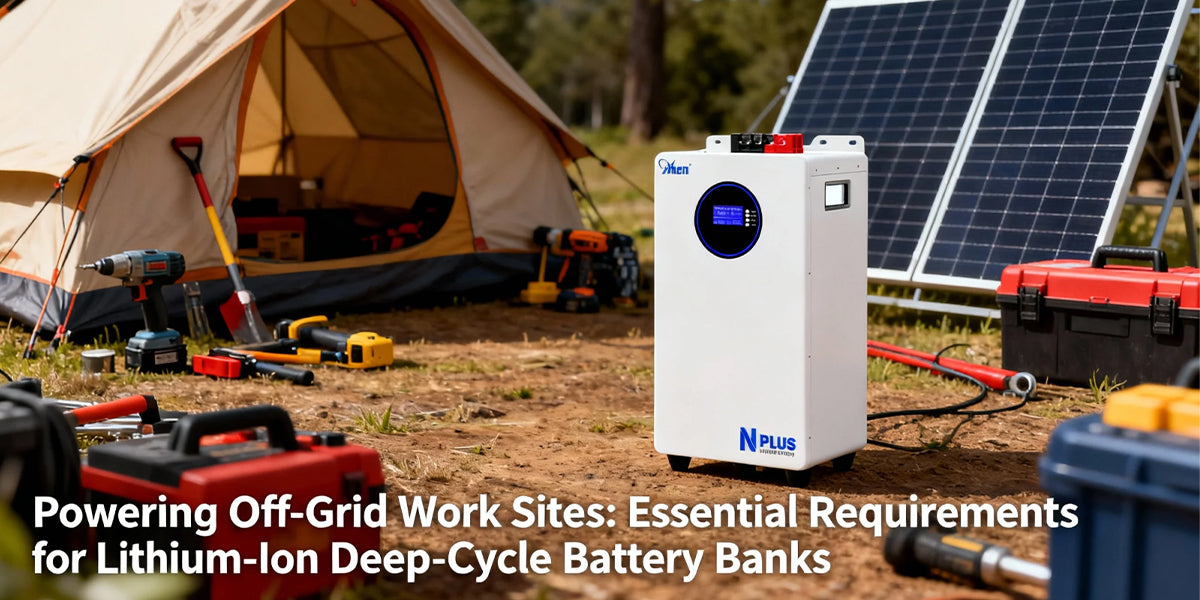
Remote crews do not get second chances with power. A tripped inverter can stop cutting, drilling, pumping, charging, and lighting in the same minute. Fuel deliveries slip. Weather changes the schedule. Tools that behave fine in a shop can behave differently on a dusty site with long cords and frequent motor starts.
A properly sized lithium-ion deep-cycle battery bank solves a specific problem: steady, repeatable power without constant babysitting. The plan still needs disciplined load data, realistic margins, and a charging path that fits the job. The sections below focus on decisions that prevent downtime and rework.
Why Off-Grid Work Site Power Plans Fail
Most job site failures trace back to predictable planning gaps. Each gap has a straightforward fix.
Surge Gets Ignored Until the First Trip
Motor loads create a short surge at startup. Compressors, pumps, saws, mixers, and some welders can spike well above running watts. If the inverter surge rating and battery discharge capability do not cover that moment, the system cuts out even though the average draw looks safe.
Fix: Collect surge or inrush requirements for every motor tool, then size the inverter surge and battery discharge rate to cover the highest combined event that can happen at once.
Duty Cycle Assumptions Drift During Real Work
A tool labeled “15 minutes per hour” can turn into “continuous for two hours” during a critical phase. A plan based on light usage collapses during production peaks.
Fix: size around the hardest expected window of the day, then add reserve for schedule compression.
Temperature and Cables Quietly Reduce Usable Power
Cold mornings reduce charge acceptance and can restrict charging. Heat accelerates aging. Long cable runs cause voltage drop and heat at the terminals. NREL publications on battery life highlight temperature, depth of discharge, and current rate as major drivers of degradation, so ignoring them risks both runtime and longevity.
Fix: apply a conservative margin for temperature and wiring, then confirm conductor sizing and termination quality.
Construction Electrical Safety Gets Treated Like an Afterthought
On construction sites, ground fault protection is not optional. OSHA rules for construction wiring require ground fault protection for cord sets and cord and plug equipment, either via GFCIs or an assured equipment grounding conductor program.
Fix: design distribution for job site practices, then verify protection devices and inspection routines.
What Power Data Should Be Collected Before Sizing a Battery Bank?
Clean inputs create a reliable battery bank design. The fastest way to get clean inputs is a simple load sheet that matches what the crew actually runs.
Load Sheet Template
Use a table like this and fill it from tool labels, manuals, and real scheduling notes.
| Load / Tool | Voltage | Running Watts | Surge or Start Watts | Quantity | Hours per Day | Notes |
Four Fields That Prevent Most Mistakes
- Running watts: Use nameplate watts or measured draw for steady operation.
- Surge or start watts: For motors, capture the highest startup event. If only amps are given, convert using the tool’s voltage and consult the manufacturer’s guidance.
- Daily runtime: Write the realistic daily hours, not the optimistic estimate.
- Simultaneous operation: Mark which loads can run together. Two tools that never overlap should not be added as a single peak.
Identify the Loads That Drive the System
Three items usually set the architecture:
- the largest motor start event
- the highest continuous load window
- the critical loads that must stay stable (comms, safety lighting, controls)
How to Size a Lithium Battery Bank
Sizing becomes manageable once everything is expressed in kWh and peak watts. The goal is enough daily energy and enough instantaneous power to handle real job conditions.
Step 1: Convert Daily Use Into kWh
For each load:
Daily kWh = (Running Watts ÷ 1000) × Hours per Day × Quantity
Add each line, then sum the total.
Step 2: Add Losses and Reserve
Every system has losses from inversion, charging, and cabling. Work sites also need a reserve for delays, weather, and unexpected tool use.
A practical planning approach:
- Add a loss margin for inverter and wiring losses
- Add a reserve margin for schedule risk
Avoid aggressive margins that leave no buffer. That leads to generator dependence or constant throttling.
Step 3: Convert kWh into Battery Capacity You Can Use
Battery labels show nominal capacity. Usable capacity depends on operating limits set by the battery management system and the depth of discharge you allow to protect life. A lithium-ion deep-cycle battery typically supports deeper usable cycling than many legacy chemistries, and it holds voltage more steadily under load. That stability helps inverters ride through surge events without sagging into shutdown.
Sample Math Using Replaceable Numbers
The math below is only a template. Swap in your own watts and hours from the load sheet.
- Tool group A totals 3.5 kWh per day
- Tool group B totals 6.0 kWh per day
- Daily total = 9.5 kWh
If you plan for losses and reserve and carry a 30 percent margin, planned daily energy becomes:
9.5 kWh × 1.30 = 12.35 kWh
If you target an operating window that keeps the bank away from extreme depletion for longevity, the nominal battery capacity needs to be higher than 12.35 kWh. The exact multiplier depends on your depth of discharge policy and the battery’s protective limits.
24V vs 48V Industrial Deep Cycle Battery Banks
Voltage choice decides current level, cable size, and how calm the system feels during heavy loads.
A quick example shows why. A 4000 W load at 24 V draws about 167 A. The same load at 48 V draws about 83 A. Lower current reduces voltage drop and heat, which matters with long runs and repeated starts.
Where 48V Tends to Win
48V fits many off-grid work site power setups because it supports:
- Higher peak power with lower current stress
- longer cable runs with less voltage drop
- cleaner inverter operation during surge events
Many industrial deep-cycle battery banks for commercial sites use 48V for those reasons.
Where 24V Still Fits
24V can work well for smaller crews with:
- short cable runs
- moderate peak loads
- a compact equipment footprint
The best choice comes from the load sheet. If peak loads and surge events are frequent, 48V often reduces headaches.
What Makes a Lithium-Ion Deep-Cycle Battery Bank Job-Site Ready?
Job site readiness is less about marketing terms and more about protections, documentation, and build quality that matches industrial use.
Safety Standards and Listings That Matter
For industrial lithium batteries, IEC 62619 covers safety requirements and tests for secondary lithium cells and batteries used in industrial applications, including stationary use. For stationary energy storage in North America, UL 1973 is commonly used for battery safety in stationary applications. For system-level safety in energy storage, UL 9540 is widely referenced. For shipping and logistics, UN 38.3 transport testing is often required for lithium batteries.
These terms belong in procurement conversations because they reduce compliance risk and improve insurability.
BMS Features That Prevent Field Failures
A job site bank should provide:
- overcurrent and short circuit protection
- high and low temperature protections for charge and discharge
- cell balancing
- clear fault signaling that technicians can interpret
A strong BMS also supports predictable performance as the bank ages, which protects the value of a lithium-ion deep-cycle battery investment.
Mechanical Durability and Serviceability
Look for:
- robust enclosure and mounting points
- protected terminals and strain relief
- connectors that tolerate vibration and handling
- service access that does not require full disassembly
Dust, movement, and repeated connections break weak hardware faster than most buyers expect.

How to Choose Charging Options for Off-Grid Work Sites
Charging determines uptime. A battery bank sized well on paper can still fail if recharge windows do not match the schedule.
Generator Charging for Fast Recovery
Generators suit sites that need a predictable recovery each day. The key is matching charger output, inverter charging capability, and battery acceptance rate so recharge time stays within available windows.
Solar and MPPT for Longer Projects
Solar can reduce fuel dependence and noise. Output depends on location, season, shading, and panel condition. Plan for reduced production on poor weather days and include realistic maintenance for dusty environments.
Shore Power and Temporary Service
Some remote sites still get periodic access to grid power. If that access exists, design the system to accept it safely and efficiently. A flexible charging architecture lets a lithium battery bank recover quickly after heavy use.
When Is the Best Portable Power Station for Construction Work Enough?
Portable systems can be excellent for the right scope. They can also become the bottleneck on tool-heavy work.
Portable Power Stations Fit Light and Mobile Tasks
The best portable power station for construction work tends to fit:
- punch list work with intermittent tools
- charging cordless tool batteries
- short deployments where fast setup matters
Confirm peak output and surge capability. Confirm the recharge plan too.
Battery Banks Fit Sustained and Scalable Loads
A dedicated bank fits when:
- Multiple corded tools run in parallel
- motors start repeatedly throughout the day
- Loads must stay stable for long shifts
- The project has a phase two expansion risk
A modular lithium battery bank can also scale more cleanly when new loads appear, provided the inverter and distribution were sized with growth in mind.
Job Site Protection Still Applies
Even with inverter-supplied power, construction rules on ground fault protection and safe cord use still matter. Build distribution like a professional temporary power setup, not like a camping rig.
Lock In Reliable Site Power Now, and Leave Room to Expand Later
A dependable plan for off-grid work site power comes from disciplined load data, conservative sizing margins, and equipment designed for industrial duty. A lithium-ion deep-cycle battery bank performs best when surge events are covered, operating temperatures are respected, and charging capacity matches the work rhythm. Safety standards and proper site distribution reduce risk and keep operations stable.
Align the load sheet with the crew’s real schedule, size for the hardest window of the day, and choose a voltage architecture that stays cool under current. Once that foundation is in place, expansion turns into a controlled upgrade instead of a rushed replacement.
FAQs
Q1: How should a battery bank be stored and handled between shifts or during transport?
For short idle periods, keep the bank in a dry, ventilated area, away from direct sun and welding sparks. Use protective covers for terminals, secure the unit against tipping, and avoid stacking heavy gear on top. Follow UN 38.3 shipping and packaging rules when applicable.
Q2: What maintenance tasks actually matter for lithium battery banks on job sites?
Most maintenance is inspection, not “battery service.” Check torque on terminals, look for discoloration or heat marks, confirm cable strain relief is intact, and keep vents and filters clean. Review BMS logs for recurring alarms. Replace damaged connectors early to prevent cascade failures.
Q3: How do you plan for winter work where charging may be restricted?
Many lithium chemistries limit charging at low temperatures. Plan a warm storage space, schedule charging during warmer hours, and consider insulated enclosures or controlled heating where allowed. If cold starts are frequent, prioritize battery specs that clearly state low-temperature charge behavior and protections.
