
01
Battery Sizing
Choose suitable storage capacity according to load and backup requirements.
Load → kWh → autonomy
Add reliable battery storage to residential, commercial and off-grid solar projects with flexible LiFePO4 battery systems and technical integration support.
Anern helps solar installers select suitable battery capacity, voltage platforms and system configurations while providing compatibility information, installation documentation and project support.
Battery storage adds new technical requirements to solar installations—from battery sizing and voltage selection to BMS communication, inverter compatibility and backup configuration.
Choose suitable storage capacity according to load and backup requirements.
Load → kWh → autonomyMatch battery voltage and communication requirements with compatible inverter platforms.
Voltage · BMS · protocolUse modular battery architectures and technical documentation to simplify deployment.
Wiring · manuals · setupSupport projects that may require additional battery capacity as energy demand grows.
Plan expansion at design stageStart from real energy demand and backup duration, then account for usable depth of discharge and overall system efficiency before choosing a voltage platform.

Use the product format that best matches the installation environment, required capacity and system voltage.
 PLATFORM SCHEMATIC
Standardized modular batteries suitable for solar system integration and capacity expansion.
Explore 48V / 51.2V batteries → PLATFORM SCHEMATIC
Flexible battery architecture for projects requiring simplified installation and modular expansion.
Explore LiFePO4 batteries → REAL ANERN PRODUCT VISUAL
High-voltage solutions for larger solar and commercial energy storage applications.
Explore high-voltage batteries → REAL ANERN PRODUCT VISUAL
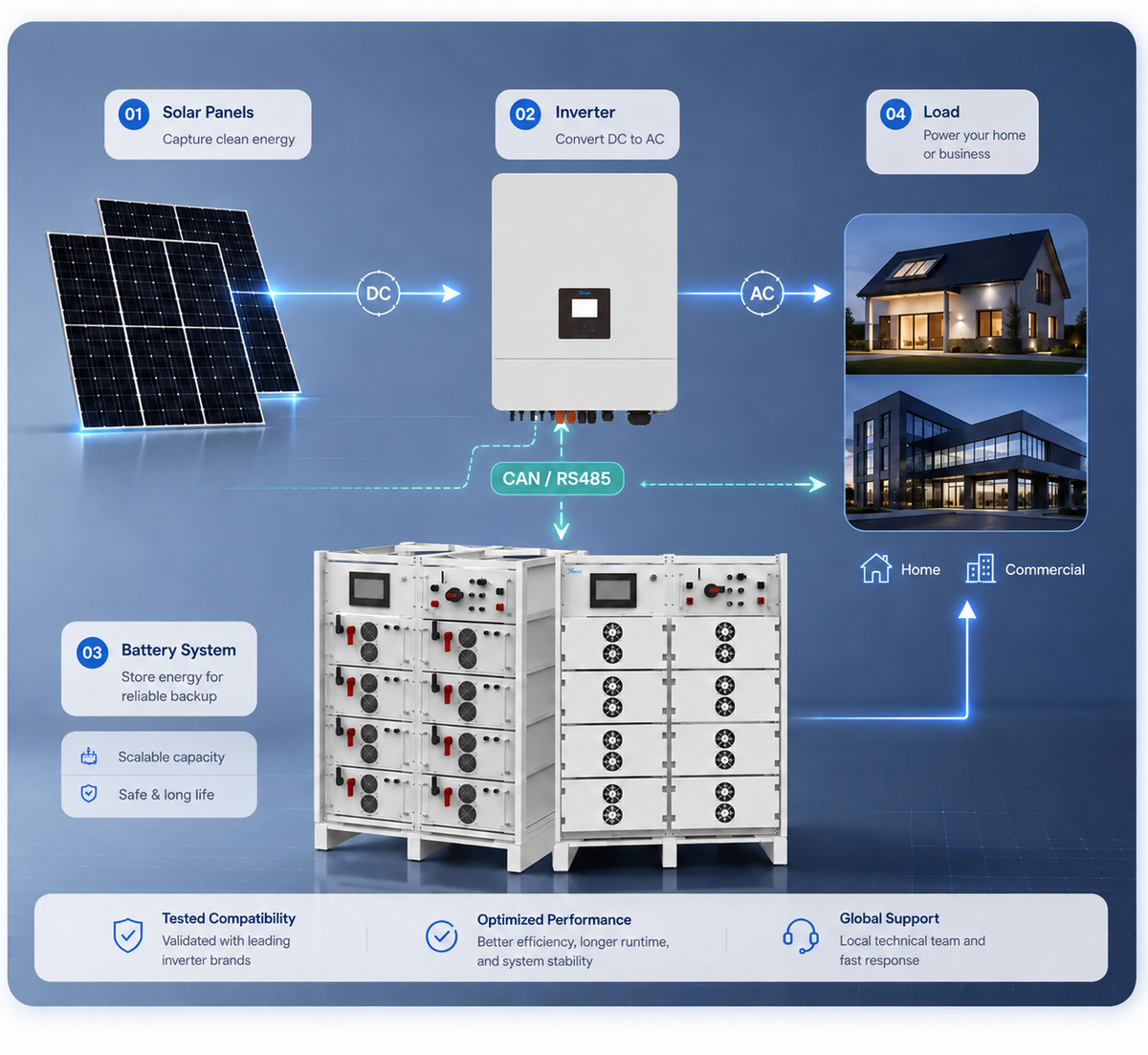
Integrated system architecture for customers seeking more streamlined energy storage deployment.
Explore integrated systems →Successful solar-plus-storage deployment depends on matching battery voltage, charge and discharge requirements, BMS communication and inverter configuration.
Anern provides product documentation and compatibility information to help installers evaluate suitable battery and inverter combinations before installation.
 FIELD INSTALLATION
Provide load demand, solar capacity, backup-hour target, inverter model and installation environment.
Choose suitable nominal energy and voltage according to load, autonomy and project scale.
Review voltage, charging limits, BMS communication and inverter configuration before deployment.
Follow model-specific wiring, cable, circuit protection, safety and commissioning documentation.
Use product documentation and technical communication to resolve configuration and commissioning questions.
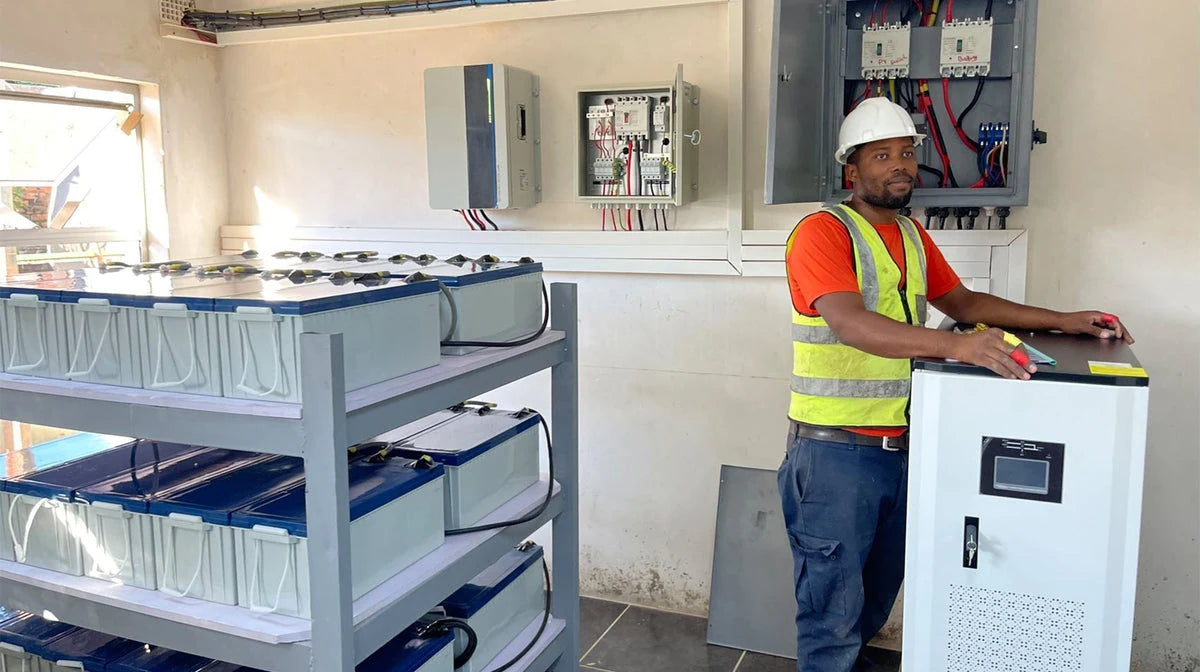
Model-specific documentation helps the installation team move from equipment selection to wiring and commissioning with fewer assumptions.
Bring sizing, integration and documentation into the installer workflow before the crew reaches site.
Estimate battery storage requirements according to load and backup duration.
Open sizing resource →Check the battery voltage, communication and inverter requirements that need confirmation.
View compatibility flow →Access wiring, installation and commissioning guidance for LiFePO4 storage systems.
Read installation guide →Understand lithium battery charging profiles and voltage requirements.
Read voltage guide →Download product catalogs, specifications and available technical documents.
Open downloads →Access product connection, installation and configuration videos published by Anern.
Watch connection videos →
Sizing guidance, inverter connection resources, product manuals and commissioning references should be available before the project reaches site.
Use these answers as a project-screening starting point, then confirm the exact product manual and inverter requirements for the selected model.
Start with the amount of energy the load needs and the required backup time. A simple estimate is: Required battery capacity (kWh) = Daily or backup energy demand (kWh) ÷ Usable battery depth of discharge ÷ System efficiency. For example, if a site needs 10 kWh of usable energy, the lithium battery supports 90% DoD, and overall system efficiency is about 90%, the required nominal capacity is approximately 12.3 kWh.
All Anern product series support communication compatibility with mainstream third-party inverter brands, including Pylontech, Growatt, Risen Energy, Pengcheng, SRNE, Victron, GoodWe, Deye, Solis, and other leading inverter manufacturers.
Low-voltage batteries typically operate around 48V or 51.2V and are commonly used in residential, small commercial and off-grid solar systems. They are relatively simple to configure and can suit projects that prioritize straightforward installation and broad hybrid-inverter compatibility. High-voltage batteries use multiple modules connected in series to create a higher system voltage and are more common in larger residential, commercial and C&I solar-plus-storage applications. At higher power levels, the higher voltage can reduce current and cable losses. Choose the voltage architecture around the inverter, power level, project scale and scalability requirements.
Model-specific installation manuals are provided for each product, covering wiring diagrams, cable sizing, circuit breaker specifications and essential safety precautions.
Yes. Anern can support off-grid solar installations with configurable LiFePO4 battery storage solutions for locations where grid power is unavailable, unstable or insufficient. Depending on the project, the system can integrate solar panels, lithium batteries, inverters and optional generators. For project evaluation, provide the load demand, solar capacity, inverter model, backup-hour requirement and installation environment so the battery capacity, voltage platform and system configuration can be assessed.
Share your load demand, PV capacity, inverter model, backup-hour requirement and installation environment to start the battery selection process.